To apply for divorce NZ, officially termed a Dissolution of Marriage, you must prove that you and your spouse have been living apart for at least two years. You must file an application with the Family Court—either jointly or individually—accompanied by your marriage certificate, proof of separation, and the required filing fee.
Ending a marriage is rarely easy, regardless of whether the decision was mutual or unilateral. In New Zealand, the legal process for ending a marriage or civil union is formally known as a “Dissolution of Marriage.” Unlike many other jurisdictions that may allow for divorce based on fault (such as adultery or unreasonable behavior), New Zealand operates on a strictly “no-fault” basis. The only ground for dissolution is that the marriage has broken down irreconcilably. This guide serves as a comprehensive resource for navigating the Family Court system, ensuring you have the knowledge to manage your application correctly and efficiently.
Understanding the Two-Year Separation Requirement
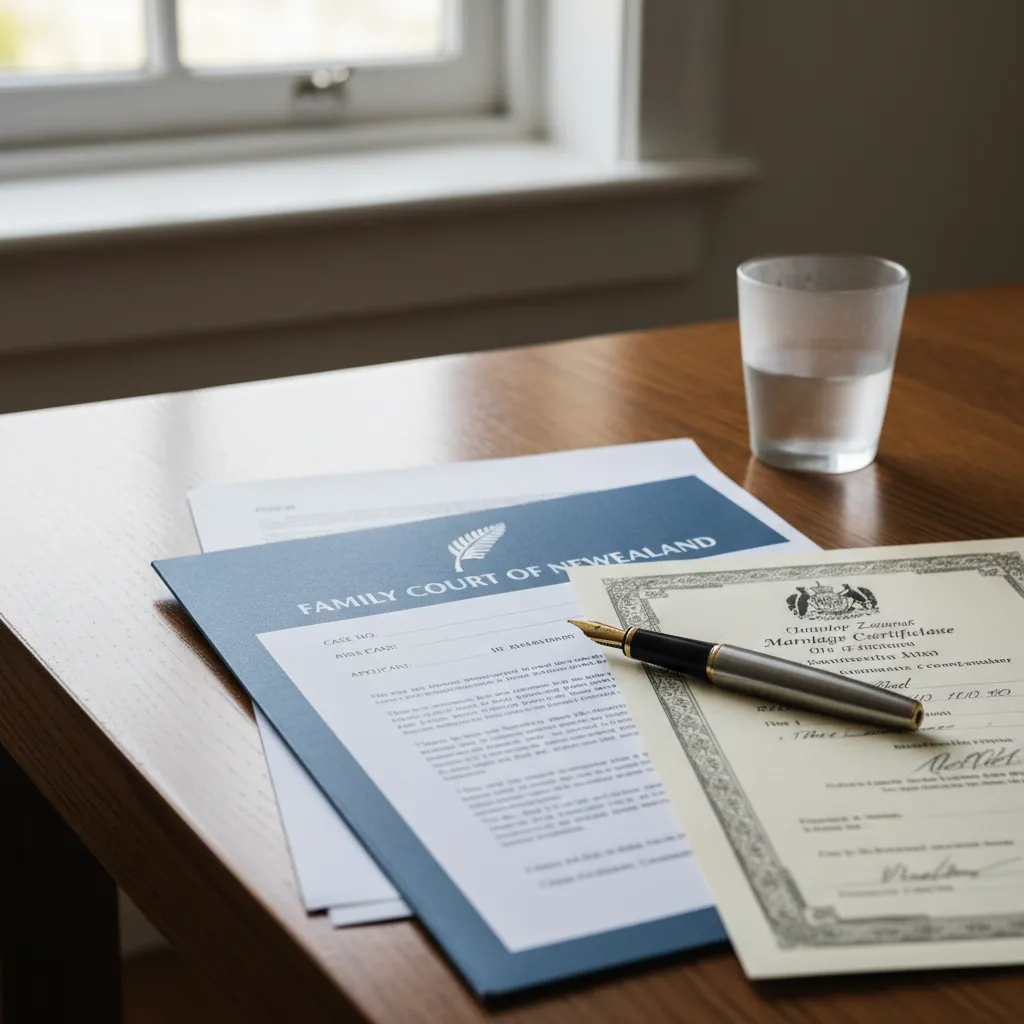
The cornerstone of New Zealand divorce law is the separation requirement. Before you can apply for a Dissolution of Marriage, you and your spouse must have been living apart for a continuous period of at least two years. This is a non-negotiable statutory requirement under the Family Proceedings Act 1980.
The Definition of Living Apart
Living apart generally means you have established separate households and are no longer living together as a couple. The court views this physical and mental separation as the definitive proof that the marriage has broken down irreconcilably. It is important to note that the two-year clock starts ticking from the day you definitively separated, not from the day you decided to divorce.
There is no requirement to register your separation legally to start this time period, though having a Separation Agreement can be useful for evidence. If you attempted to reconcile during this two-year period, the law allows for a resumption of cohabitation for a total period of up to three months without resetting the two-year clock. This provision exists to encourage couples to attempt reconciliation without the fear of penalizing their legal timeline if it does not work out.
Joint vs. Single Applications: Which Path to Take?
When you are ready to apply for divorce NZ, you must determine whether you will file a Joint Application or a Single Application (often called a one-party application). The path you choose significantly dictates the speed and complexity of the process.
Joint Application (Recommended)
A joint application is the most streamlined method. This occurs when both parties agree that the marriage is over and are willing to sign the documents together. In this scenario:
- Both spouses sign the affidavit.
- There is no need to “serve” documents on the other person.
- The process is faster, often taking roughly one month to be processed by the Registrar.
- You can ask the Registrar to make the order without a court appearance.
Single Application
A single application is necessary when one spouse does not agree to the divorce, or if you cannot locate your spouse. In this scenario:
- You (the applicant) file the papers alone.
- You must legally “serve” the documents to your spouse (the respondent).
- The respondent has a specific timeframe to defend the application if they disagree with the separation date or jurisdiction.
- This process takes longer and incurs higher administrative effort.
The Step-by-Step Filing Process
Navigating the paperwork can be daunting. Below is the detailed procedure for filing your application with the Ministry of Justice.
Step 1: Gather Required Documents
Before filling out any forms, ensure you have the original or a certified copy of your marriage or civil union certificate. If you do not have this, you must order a copy from Births, Deaths and Marriages. If your marriage certificate is in a foreign language, you must provide an official translation.
Step 2: Complete the Application Forms
The forms differ based on your application type:
- For Joint Applications: You will complete form FP11 (Joint Application for Order Dissolving Marriage or Civil Union). Both parties must swear or affirm the truth of the contents before a Registrar, Justice of the Peace, or a solicitor.
- For Single Applications: You will complete form FP12 (Application by One Party for Order Dissolving Marriage or Civil Union). Only the applicant signs this.
Step 3: Swearing the Affidavit
The application forms include an affidavit section. This is a sworn statement confirming that you have been separated for two years and that appropriate arrangements have been made for any children of the marriage. You cannot just sign this at home; it must be witnessed by an authorized person, such as a Court Registrar or a lawyer.

Filing Fees and Court Costs
As of the current fee structure, the cost to file an application for a Dissolution of Marriage is approximately $211.50 NZD. This fee applies regardless of whether you are filing a joint or single application. This fee covers the court’s administrative costs to process the paperwork and issue the Dissolution Order.
It is important to check the official Ministry of Justice website for the most up-to-date fee schedule, as these can change.
Fee Waivers
If you are unable to pay the filing fee due to financial hardship, you may be eligible for a fee waiver. To apply for this, you must complete a “Request for Waiver of Civil Fees” form and provide evidence of your financial situation (e.g., benefit summaries or bank statements). If granted, the Registrar will waive the $211.50 fee.
Service of Documents for Single Applications
If you are filing a single application, the most critical legal hurdle is Service. You cannot simply hand the divorce papers to your ex-spouse yourself. The law requires that an independent person serves the documents to ensure the respondent is aware of the proceedings and has a chance to respond.
Methods of Service
You must arrange for a professional process server, a court bailiff, or a mutual friend (who is over 18 and not involved in the case) to hand the documents to your spouse. The server must then complete an “Affidavit of Service” proving they delivered the documents.
What if I Cannot Find My Spouse?
If you do not know where your spouse lives, you cannot proceed with standard service. You must apply to the court for “Substituted Service.” This involves asking the court for permission to serve the documents via alternative methods, such as through a relative, via email, or even through social media (Facebook), provided you can prove the account is active and belongs to them.
Separation Under One Roof
A common complication in New Zealand housing markets is when couples separate but continue living in the same house for financial reasons. Can you still apply for divorce? Yes, but the burden of proof is higher.
If you lived in the same house during the two-year separation period, you must file an additional affidavit. This document must detail how you led separate lives despite sharing an address. Evidence may include:
- Sleeping in separate bedrooms.
- Cooking and eating meals separately.
- Doing your own laundry and household chores individually.
- Ceasing all sexual intimacy.
- Presenting yourselves to family and friends as separated.
The court requires a corroborating affidavit from a third party (a friend, neighbor, or family member) who can verify that you were indeed living separate lives while under the same roof.
Processing Times and Final Orders
Once the application is filed, the timeline depends on the type of application.
Timeline for Joint Applications
Joint applications are generally processed administratively. If all paperwork is in order, the Registrar will review the file. It usually takes about one month for the Dissolution Order to be made. The order becomes final one month after it is issued.
Timeline for Single Applications
For single applications, once the documents are served, the respondent has 21 days (if in New Zealand) to file a defense. If they do not respond within that timeframe, you can apply to have the case heard on an undefended basis. This process can take several months depending on how quickly service is effected and court schedules.
Once the Dissolution Order is granted, your marriage is legally dissolved. You are then free to remarry or enter into a new civil union.
Frequently Asked Questions
Below are common questions regarding the process to apply for divorce NZ, addressing specific nuances of Family Law.
Can I get a divorce in NZ if we have been separated for less than two years?
No. New Zealand law strictly requires a two-year separation period to prove the marriage has irreconcilably broken down. There are no shortcuts or exceptions to this time requirement, regardless of the reasons for the split.
Do I need a lawyer to apply for divorce in NZ?
No, you do not legally need a lawyer to file for a Dissolution of Marriage. The process is designed to be accessible for individuals to do themselves. However, if there are complex issues regarding service or if the divorce is defended, legal advice is highly recommended.
Does divorce cover custody and property division?
No. The Dissolution of Marriage is a separate legal process from the division of relationship property or care of children arrangements. These issues are handled under different laws (Property (Relationships) Act and Care of Children Act) and can be resolved before, during, or after the divorce is finalized.
What happens if my spouse refuses to sign the divorce papers?
If your spouse refuses to sign, you must file a Single Application. You will then need to have the documents formally served to them. They cannot stop the divorce simply by refusing to sign, provided you can prove the two-year separation.
Can I apply for divorce in NZ if I was married overseas?
Yes, you can apply for a divorce in New Zealand for an overseas marriage as long as at least one of you is domiciled (permanently based) in New Zealand when the application is made.
How much does a divorce cost in New Zealand?
The filing fee paid to the court is approximately $211.50 NZD. If you hire a lawyer to assist you, their legal fees will be an additional cost on top of the court filing fee.
For more detailed information on legislation, you can refer to the Family Proceedings Act 1980. Completing a Dissolution of Marriage marks the legal end of a relationship, allowing both parties to move forward. While the paperwork may seem administrative, ensuring accuracy in your application will prevent delays and help close this chapter of your life with dignity.