
Post separation abuse is a strategic pattern of coercive control that continues or escalates after a relationship ends, utilized by a toxic ex-partner to maintain dominance. It manifests through counter-parenting, financial withholding, legal harassment, and stalking, aimed at destabilizing the victim’s life and undermining their capacity to parent.
Understanding the Post-Separation Abuse Wheel
Leaving a high-conflict relationship or a narcissist does not guarantee freedom. For many survivors, the end of the relationship marks the beginning of a more insidious phase known as post-separation abuse. While the physical proximity may have changed, the abuser’s desire for control remains constant, often intensifying when they realize they have lost direct access to their victim.
The Post-Separation Abuse Wheel is a conceptual framework adapted from the traditional Duluth Power and Control Wheel. It illustrates the specific, non-physical tactics abusers use to terrorize their former partners through the family court system, co-parenting apps, and financial entanglements. In the context of high-conflict divorce psychology, particularly within jurisdictions like New Zealand where the “best interests of the child” are paramount, abusers often weaponize these very principles to paint the safe parent as unstable or uncooperative.
Unlike standard relationship conflict, which usually resolves with time/distance, post-separation abuse is relentless. It is not driven by the stress of divorce but by a pathological need to win and to punish the partner for leaving. Understanding the spokes of this wheel is the first step in dismantling it.
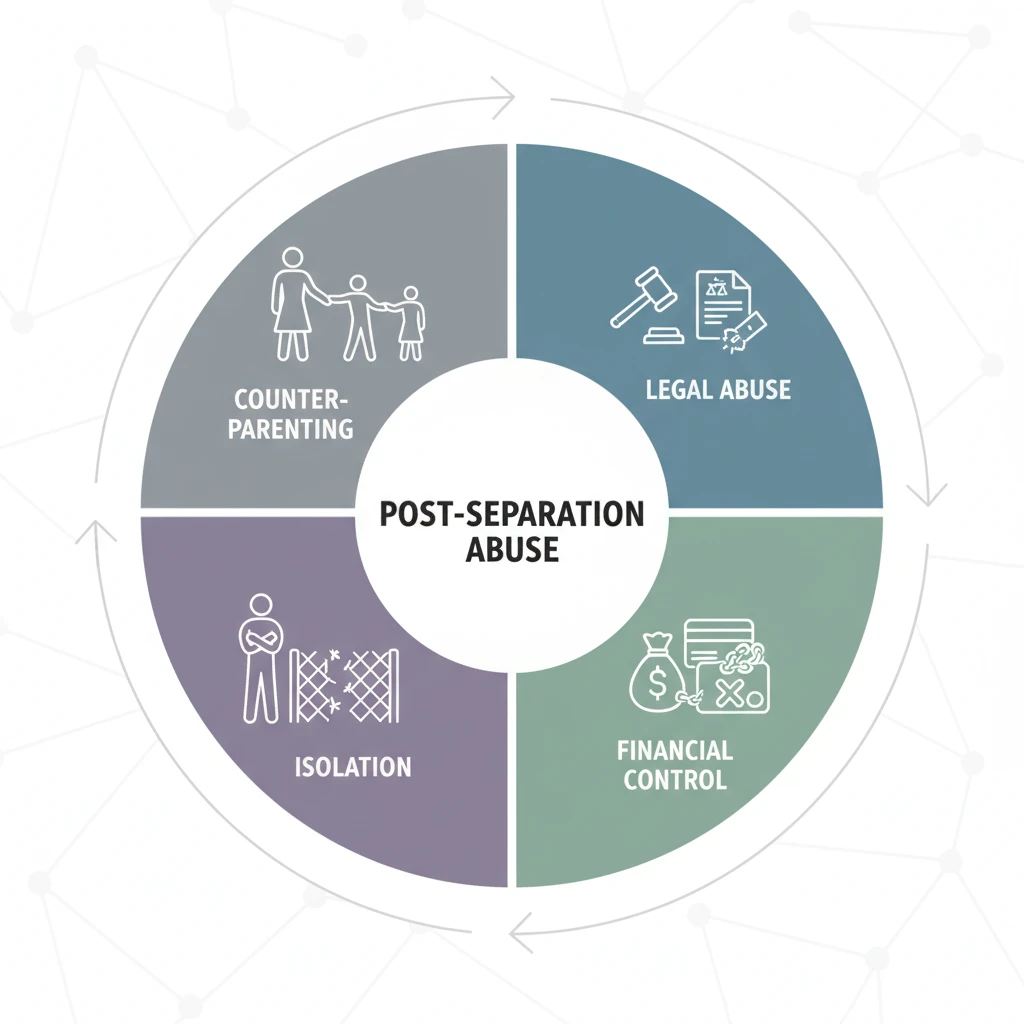
Counter-Parenting and Alienation Tactics
One of the most painful aspects of the post-separation abuse wheel is the weaponization of children. In a healthy divorce, parents strive for co-parenting. In an abusive dynamic, the toxic ex-partner engages in “counter-parenting.” This is not merely a difference in parenting styles; it is an active attempt to undermine the other parent’s authority and emotional bond with the child.
The Mechanics of Counter-Parenting
Counter-parenting involves doing the opposite of what the safe parent does, specifically to cause friction. If you set a bedtime routine, the counter-parent keeps the children up late. If you restrict screen time, the counter-parent offers unlimited access. The goal is to make the safe parent appear “strict” or “controlling” while the abuser positions themselves as the “fun” parent.
Alienation and Isolation
While the term “parental alienation” is controversial in some legal circles, the behaviors associated with it are very real components of post-separation abuse. These behaviors include:
- Disparagement: Speaking negatively about the victim in front of or directly to the children.
- Erasure: Removing photos of the other parent or refusing to acknowledge their existence during their parenting time.
- Interference: Scheduling activities during the other parent’s custodial time or excessive calling/texting to intrude on that time.
- Withholding Information: Refusing to pass on school notices, medical updates, or social invitations to ensure the other parent looks negligent or uninvolved.
This psychological manipulation places children in a severe loyalty bind, forcing them to choose sides to survive the emotional climate created by the abuser.
Financial Withholding and Economic Abuse
Financial abuse rarely ends when the separation papers are filed. In fact, the separation process often provides the abuser with new avenues to exploit financial vulnerabilities. This quadrant of the wheel is designed to starve the victim into submission or bankruptcy, forcing them to return to the relationship or concede to unfair custody arrangements.
Tactics of Economic Control
Common strategies include:
- Non-Compliance with Support Orders: Refusing to pay child support or spousal maintenance, or paying it sporadically to prevent the victim from budgeting effectively.
- Hiding Assets: Moving funds to offshore accounts, “gifting” money to relatives, or underreporting income (especially common with self-employed narcissists) to minimize support obligations.
- Debt Generation: Running up debt on joint credit cards before accounts are frozen or delaying the sale of the matrimonial home to erode the victim’s equity.
- Interfering with Employment: Harassing the victim at their workplace or causing childcare crises that force the victim to miss work, jeopardizing their financial independence.
According to Women’s Refuge NZ and other global advocacy groups, economic abuse is a primary reason victims are unable to leave or stay separated from abusive partners. The abuser knows that legal fees are expensive; by cutting off resources, they strip the victim of their ability to retain quality legal counsel.
Stalking, Harassment, and Digital Surveillance
In the digital age, the post-separation abuse wheel has expanded into the technological realm. Stalking is no longer limited to physically following a person; it is now pervasive, constant, and often automated.
Cyber-Stalking and Monitoring
Abusers often utilize technology to maintain a sense of omnipresence in the victim’s life. This creates a psychological state of siege, where the victim feels they are never truly alone or safe. Tactics include:
- Tracking Devices: Hiding AirTags or GPS trackers in the children’s backpacks, toys, or the victim’s vehicle.
- Spyware: Installing keyloggers or monitoring apps on shared devices or the children’s iPads to read the victim’s private communications with lawyers or therapists.
- Social Media Harassment: Creating fake profiles to monitor the victim’s posts, or using social media to smear the victim’s reputation publicly (cyber-bullying).
Harassment via Communication Channels
Even required communication regarding the children can become a tool for abuse. “Text terrorism” involves sending dozens of hostile emails or messages per day, burying the victim in a barrage of accusations and demands. These messages often oscillate between feigned concern (“I’m just worried about the kids”) and overt threats, designed to keep the victim in a state of high cortisol and emotional dysregulation.

Legal Bullying and Procedural Abuse
Perhaps the most devastating spoke of the wheel is legal abuse, often termed “vexatious litigation” or “paper terrorism.” The abuser uses the Family Court system not to resolve disputes, but to harass the victim, deplete their finances, and exhaust their emotional reserves.
This form of abuse is particularly effective because it operates under the guise of “concern for the child” or “seeking justice.” Signs of legal abuse include:
- Repeated Filings: Filing frivolous motions or applications for trivial matters.
- Delay Tactics: Continuously requesting adjournments, changing lawyers, or failing to file documents on time to drag out proceedings for years.
- False Allegations: Making unfounded reports to Child Protective Services (Oranga Tamariki in NZ) or police to damage the victim’s credibility.
- Self-Representation: The abuser may choose to represent themselves to directly cross-examine the victim, using the court setting to continue the intimidation.
Research published by the Psychology Today network highlights that legal and administrative aggression is a hallmark of narcissistic abuse, as it allows the abuser to maintain contact and control through a third party (the judge).
Educating Your Lawyer and Family Court Professionals
One of the greatest challenges victims face is that the legal system often assumes both parties are acting in good faith. In high-conflict divorce cases involving post-separation abuse, this assumption is dangerous. Lawyers and judges may view the constant conflict as “it takes two to tango,” failing to recognize the unilateral nature of the abuse.
Bridging the Understanding Gap
To protect yourself, you must effectively communicate the nature of the abuse to your legal representation. Do not assume they understand the dynamics of coercive control.
- Focus on Patterns, Not Incidents: When speaking to your lawyer, do not just list isolated incidents. Explain the pattern of behavior. Use the “Post-Separation Abuse Wheel” as a framework to categorize the events.
- Documentation is Key: Maintain a factual, unemotional log of events. Use a dedicated parenting app (like OurFamilyWizard) if possible, as these records are admissible in court and cannot be altered. Document missed visitations, hostile messages, and financial discrepancies.
- Use the Right Terminology: Instead of saying “he is mean,” use specific terms like “coercive control,” “legal bullying,” “financial withholding,” and “counter-parenting.” This frames the behavior in a way that legal professionals can address.
- Request Specific Orders: Ask your lawyer to advocate for court orders that limit the abuser’s ability to manipulate. This might include parallel parenting plans, strict communication protocols (e.g., email only, once a day), and clear consequences for non-compliance.
Strategies for Protection and Recovery
Surviving post-separation abuse requires a shift in strategy. You cannot “co-parent” with an abuser; you must “parallel parent.” This means disengaging from the conflict and minimizing contact.
Establish iron-clad boundaries. Do not respond to personal attacks; reply only to logistics regarding the children using the “BIFF” method (Brief, Informative, Friendly, and Firm). Lock down your digital life by changing passwords and checking devices for trackers. Most importantly, build a support network of professionals who understand high-conflict dynamics—therapists, divorce coaches, and trauma-informed lawyers.
The Post-Separation Abuse Wheel spins on the momentum of your reaction. By stepping out of the chaos, documenting the behavior, and strictly adhering to boundaries, you can slowly jam the spokes of the wheel and begin to reclaim your peace.
People Also Ask
What are the signs of post separation abuse?
Signs include harassment via text or email, stalking (digital or physical), financial withholding, using the court system to intimidate (legal abuse), and counter-parenting tactics designed to alienate the children from the safe parent.
How do you prove post separation abuse in court?
Proof requires meticulous documentation. Keep a factual log of all interactions, save all hostile emails and texts, document missed visitations, and record financial discrepancies. Utilizing court-approved communication apps can provide an unalterable record of abuse.
What is the difference between high conflict and post separation abuse?
High conflict implies both parties are engaging in the dispute. Post-separation abuse is unilateral; one party is the aggressor using coercive control tactics, while the other party is attempting to set boundaries and protect themselves and the children.
Can post separation abuse cause PTSD?
Yes, the chronic stress, fear, and hypervigilance required to navigate post-separation abuse can lead to Post-Traumatic Stress Disorder (PTSD) or Complex PTSD (C-PTSD), often referred to as Post-Separation Abuse Disorder.
How do you co-parent with a post separation abuser?
Experts recommend “parallel parenting” rather than co-parenting. This involves minimizing contact, communicating only in writing about logistics, and keeping households completely separate with distinct rules to reduce the abuser’s opportunity for conflict.
Is financial withholding considered domestic violence?
Yes, financial withholding is a form of economic abuse, which is recognized as a form of family violence in many jurisdictions, including New Zealand. It is used to trap the victim and limit their ability to seek legal help or independence.