
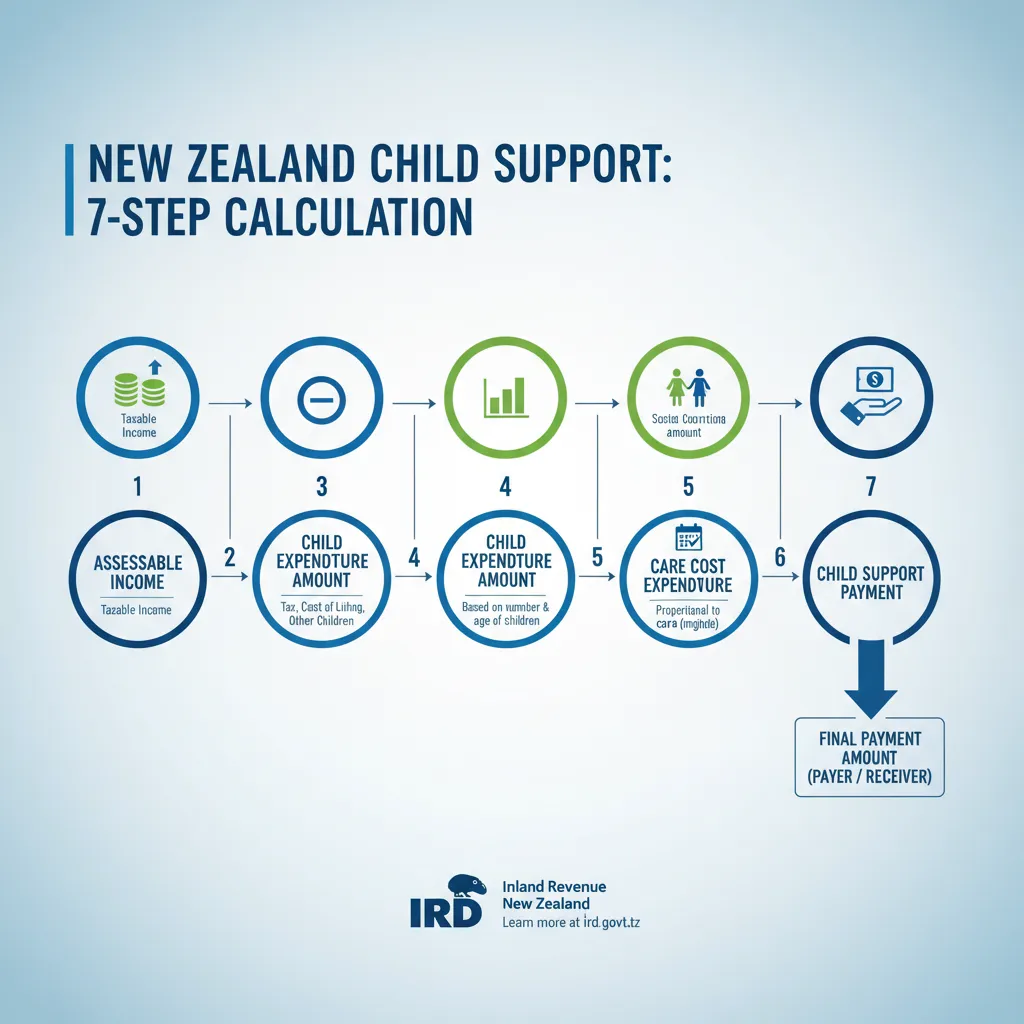
To calculate child support in NZ, Inland Revenue (IRD) uses a comprehensive seven-step formula outlined in the Child Support Act 1991. This calculation considers the combined income of both parents, their respective care percentages for the children, and the estimated costs of raising children based on their age and number. It aims to ensure a fair and consistent approach to parental financial responsibility.
The IRD Child Support Formula Explained: A Deep Dive into New Zealand’s Model
Child support in New Zealand is administered by Inland Revenue (IRD), operating under the Child Support Act 1991. This legislation establishes a clear framework for determining financial contributions from parents towards the upbringing of their children. The underlying principle is that both parents have a financial responsibility for their children, regardless of their relationship status. The IRD’s role is not just to collect and disburse payments but also to calculate the appropriate amount using a standardised, objective formula designed to ensure fairness and consistency across all cases.
Understanding the Core Principles of the Child Support Act 1991
At its heart, the Child Support Act 1991 is predicated on the idea that children have a right to be financially supported by both parents. It moves away from subjective court decisions by providing a formulaic approach. Key principles include:
- Parental Responsibility: Both parents are expected to contribute to the financial well-being of their children.
- Children’s Needs First: The formula is designed to cover a reasonable portion of the costs of raising children.
- Fairness: Contributions are proportionate to each parent’s income and their level of care for the children.
- Transparency: The formula provides a clear, understandable method for calculation.
The IRD acts as a neutral administrator, applying the formula, collecting payments from the paying parent, and passing them on to the receiving parent. This system helps to reduce direct conflict between parents over financial matters, providing a structured and reliable mechanism for support.
The Seven-Step Formula: A Guided Walkthrough
The IRD employs a seven-step process to determine the child support amount. Understanding each step is crucial for comprehending the final figure:
- Calculate the Parents’ Combined Income: The IRD first ascertains the taxable income for both the receiving and paying parents. This can include wages, salaries, self-employment income, benefits, and certain investment earnings. This combined figure forms the basis for assessing the total financial capacity for child support.
- Determine the Child Support Income of Each Parent: From each parent’s gross income, certain deductions are made to arrive at their individual ‘child support income’. These deductions typically include a living allowance to ensure parents can meet their own basic needs and, where applicable, amounts for other qualifying children not part of this child support assessment.
- Calculate the “Child Support Income Amount”: This step involves summing up the individual child support incomes of both parents to establish a total available income pool for the children’s support.
- Determine the “Cost of Raising Children” (CRC): The IRD uses a set schedule, based on research into the average costs of raising children in New Zealand, to determine the annual cost for the number and age of children involved. This schedule accounts for variations in expenses as children grow older. For example, teenagers generally cost more to raise than infants.
- Apportion the CRC Between Parents: Based on each parent’s proportion of the total “child support income amount” (from step 3), the CRC (from step 4) is divided between them. If one parent earns 70% of the combined child support income, they are initially responsible for 70% of the CRC.
- Account for Care Arrangements (Shared Care Adjustments): This is a critical step. The amount each parent is responsible for is then adjusted based on the number of nights each child spends in their care. The more nights a parent cares for the child, the more of their own share of the CRC they are deemed to be meeting directly. This reduces the amount they would otherwise pay or increases the amount they might receive. For instance, a parent with 50/50 care would have their financial contribution significantly reduced or balanced.
- Apply Administrative Charges and Minimum Payments: Finally, administrative charges may be applied. There’s also a minimum child support payment amount set by the IRD, ensuring a baseline contribution even if calculations yield a very low figure.
Key Terminology: What You Need to Know
Navigating child support requires understanding specific terms:
- Receiving Parent: The parent who receives child support payments.
- Paying Parent (or Liable Parent): The parent who makes child support payments.
- Qualifying Child: A child under 18 (or up to 19 if still at secondary school) who is not married or in a civil union and is not financially independent.
- Child Support Income: A parent’s taxable income minus allowable deductions, used in the formula.
- Net Child Support Income: The final income figure after all relevant deductions and allowances have been applied, which directly feeds into the calculation of their contribution.
Income Assessment and Factors Influencing Child Support Calculations
The accuracy of child support calculations hinges significantly on a precise assessment of each parent’s income and various other contributing factors. The IRD’s process is designed to capture a comprehensive view of financial capacity, while also allowing for certain deductions and adjustments to reflect individual circumstances.
What Income is Included? Taxable vs. Untaxable
The IRD primarily uses a parent’s taxable income as reported for tax purposes. This includes, but is not limited to:
- Salaries and wages
- Self-employment income (profit from business)
- Social security benefits and pensions
- Income from investments (e.g., interest, dividends, rental income)
- Fringe benefits that are taxable
The IRD has direct access to income information reported by employers and individuals, making their assessment generally robust. Untaxable income, such as inheritances or gifts, is typically not included unless it significantly alters a parent’s financial position in a way that warrants an administrative review.
Allowable Deductions: Reducing Your Assessable Income
To ensure fairness, the IRD allows certain deductions from a parent’s gross income before calculating their child support income. These can significantly impact the final payment amount:
- Living Allowance: A statutory living allowance is automatically deducted from each parent’s income to cover their basic living costs. This ensures that child support payments do not render a parent unable to meet their own essential needs.
- Dependent Children from Other Relationships: If a parent has other qualifying children for whom they are financially responsible, either through a prior child support assessment or by having them in their care, an allowance can be deducted for these children. This acknowledges their broader parental responsibilities.
- Court-Ordered Payments: Certain court-ordered payments, such as spousal maintenance, may also be considered as deductions.
- Student Loan Repayments: While not a direct deduction in all cases, significant student loan repayment obligations can be a factor considered during an administrative review if they are causing undue hardship.
It’s crucial for parents to ensure their income and deduction information provided to the IRD is accurate and up-to-date.
Recognizing Care Arrangements: The Impact of Shared Care
The amount of time each parent spends caring for the children is a major factor in the child support calculation. The IRD uses specific thresholds for overnight care to adjust the final support amount:
- Less than 29% care: The parent is considered the paying parent (if income warrants).
- 29% to 39% care: A small adjustment is made to the paying parent’s obligation.
- 40% to 49% care: A significant adjustment, as the paying parent is meeting a substantial portion of the children’s costs directly.
- 50% or more care: This often results in a lower child support payment for the parent with more care, or a situation where both parents’ obligations net off. If care is exactly 50/50, and incomes are similar, child support may be zero, or the higher earner pays a smaller amount to the lower earner.
These care percentages are determined by the number of nights the children spend with each parent annually. Accurate records of care arrangements are vital. Parents often agree on care arrangements through parenting plans, which can then be used to inform the IRD’s assessment.

Estimating Income: When and How to Apply
The IRD’s standard calculation relies on historical income data. However, life circumstances can change rapidly. If a parent’s income significantly increases or decreases by at least 15% (or a minimum threshold) due to job loss, a new job, illness, or starting a business, they can apply for an estimated income assessment.
Process:
- Parents must provide a reasonable estimate of their future income for the child support year.
- Supporting documentation (e.g., redundancy notice, new employment contract) is often required.
- The IRD will use this estimate for the current child support year.
Consequences of Underestimating: It’s critical to provide an honest and accurate estimate. If a parent substantially underestimates their income and it turns out to be higher, they may face backdated child support payments, penalties, and interest charges. The IRD regularly reconciles estimated income with actual income at the end of the tax year.
Reviewing Child Support: Adapting to Change of Circumstances
Child support is not a static amount; it’s a dynamic calculation designed to adapt to the changing lives of parents and children. New Zealand’s system provides several mechanisms for review and adjustment, ensuring the support remains fair and appropriate over time.
Annual Reassessments by IRD
Every year, the IRD automatically reassesses child support based on the latest available income information (usually from the previous tax year). This means that as incomes naturally fluctuate, so too will the child support amount. Parents do not need to apply for this; it’s part of the standard IRD process. This annual review ensures that the calculations stay current without constant intervention from parents.
Grounds for an Administrative Review
Sometimes, the standard formula doesn’t fully capture a parent’s true financial capacity or the children’s specific needs. In such cases, a parent can apply for an administrative review. An administrative review considers specific circumstances that may warrant a departure from the formula. Grounds for review include, but are not limited to:
- High Costs for Special Needs Children: If a child has specific medical, educational, or disability-related costs that are significantly higher than average.
- Income Derived from Assets: Where a parent has significant assets but low taxable income (e.g., substantial property investments with negative gearing), the formula might not accurately reflect their ability to pay.
- Unusual Income Patterns: Parents with highly variable or irregular income (e.g., seasonal workers, commission-only roles) might benefit from a review.
- High Housing Costs: If a parent has exceptionally high housing costs for themselves and the children in their care.
- Other Commitments: Significant financial commitments that prevent a parent from meeting their basic living costs after child support.
The administrative review process requires detailed documentation and evidence to support the claims. An IRD review officer will consider all evidence and make a decision to either vary the formula assessment or confirm it.
Applying for a Child Support Agreement
Parents can also agree on a child support amount that differs from the IRD’s formula assessment. This is known as a child support agreement. These agreements are often preferred when parents have a good co-parenting relationship and want more flexibility or a tailored approach. The agreement must be:
- In writing.
- Signed by both parents.
- Lodged with the IRD to make it legally binding and enforceable.
Advantages: Greater flexibility, potential for including non-cash contributions, and fostering cooperation. Limitations: The IRD can refuse to accept an agreement if it’s not in the best interests of the children or if it falls below the minimum child support rate. They also provide collection and enforcement services for registered agreements.
Court Orders and Departures from the Formula
In more complex or contentious cases, or where an administrative review has been unsuccessful, either parent can apply to the Family Court for a departure order. A departure order overrides the IRD’s formula assessment. Grounds for a court to order a departure include similar factors to an administrative review, but the court has broader discretion and can consider a wider range of circumstances. This is typically a last resort, as it involves legal costs and is a more adversarial process. The court’s primary consideration will always be the best interests of the children involved.
Practical Steps for Calculating and Managing Your Child Support
Understanding the theory behind child support is one thing; navigating the practicalities is another. Here are some actionable steps to help you calculate and manage your child support obligations or entitlements effectively in New Zealand.
Using the IRD Child Support Calculator
The Inland Revenue Department provides an online Child Support Calculator, an invaluable tool for parents. This calculator allows you to get an estimate of what your child support payments might be. It asks for key information such as:
- Your income and the other parent’s income.
- The number of qualifying children.
- The care arrangements (number of nights spent with each parent).
- Details about other dependent children.
Accessing the Tool: You can find this calculator on the official IRD website. Remember that this tool provides an estimate only. The final assessment will be made by the IRD based on verified information.
What to Do if You Disagree with an Assessment
If you receive a child support assessment from the IRD and believe it’s incorrect or unfair, you have avenues to challenge it:
- Check the Details: First, carefully review the assessment. Are the income figures correct? Are the care percentages accurate? Often, simple data entry errors or outdated information can be the cause.
- Contact IRD: If you identify a factual error, contact the IRD immediately to have it corrected.
- Administrative Review: If the issue isn’t a simple error but relates to special circumstances not adequately captured by the formula (as discussed in the previous section), apply for an administrative review. You’ll need to provide detailed information and supporting evidence.
- Objection: If you disagree with the decision made during an administrative review, or believe the IRD has misinterpreted the law, you can formally object to the assessment. This is a more formal process.
- Seek Legal Advice: For complex cases, or if you are considering a departure order through the Family Court, it is highly recommended to seek independent legal advice from a family law professional. They can guide you through the process and help you present your case effectively.
The Importance of Communication and Documentation
Effective management of child support is significantly enhanced by clear communication and meticulous record-keeping:
- Communicate with the Other Parent: While the IRD manages the formal aspects, maintaining open and respectful communication with the other parent about changes in income, care arrangements, or significant child-related expenses can prevent misunderstandings and disputes.
- Keep Records: Maintain thorough records of everything related to child support. This includes:
- All correspondence with the IRD.
- Income statements and tax returns.
- Records of care arrangements (e.g., a calendar showing overnight stays).
- Receipts for any agreed-upon additional child expenses (if not part of the formula).
- Update IRD Promptly: Inform the IRD without delay if there are significant changes to your income, living situation, or care arrangements. This proactive approach can prevent future complications, penalties, or large lump-sum adjustments.
By taking these practical steps, parents can navigate the child support system in New Zealand with greater confidence and ensure that their children receive the financial support they are entitled to, in a manner that is fair to both parents.