
Trusts and relationship property NZ involves the legal evaluation of trust assets to determine if they are subject to division under the Property (Relationships) Act 1976. While trusts are often used to protect assets, courts can order compensation or set aside dispositions if the trust was established or managed to defeat a partner’s relationship property rights.
The Intersection of Trusts and Relationship Property in New Zealand
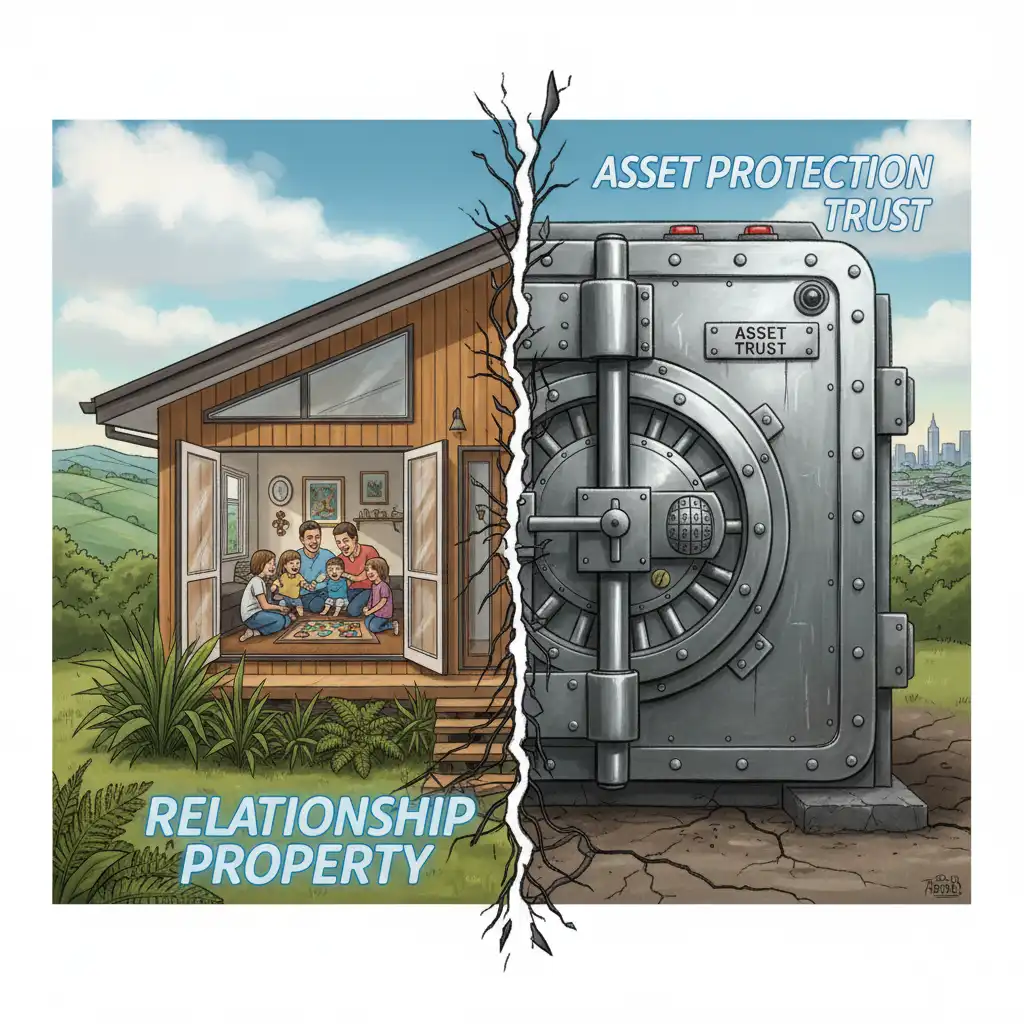
In the landscape of New Zealand family law, few areas are as contentious or legally complex as the interface between discretionary family trusts and the Property (Relationships) Act 1976 (PRA). For decades, New Zealanders have had a love affair with trusts, often utilizing them as the primary vehicle for asset protection. However, when a relationship breaks down, the trust structure often transforms from a benign financial planning tool into a weapon of financial exclusion.
The fundamental tension lies between the concept of trust law—where assets are legally owned by trustees, not the individuals—and relationship property law, which presumes an equal sharing of assets acquired during the relationship. When the family home or significant investments are locked inside a trust, a non-beneficiary partner, or even a beneficiary partner with no power of appointment, may find themselves legally severed from the wealth they helped build.
Understanding trusts and relationship property NZ requires navigating a minefield of case law and statutory provisions designed to balance the sanctity of the trust deed against the equitable rights of a disadvantaged partner. It is not merely a financial calculation; it is a legal battleground where the history of the relationship meets the rigid structures of property law.
The Psychological Motive: The Control Freak’s Obsession
While lawyers focus on the statutes, it is crucial to understand the psychological underpinnings of why assets are hidden in trusts. In the context of high-conflict divorce and separation, the use of a trust is rarely about tax efficiency alone; it is frequently about control.
In relationships characterized by power imbalances, one partner often exhibits traits of financial narcissism or obsessive control. For this individual, the trust serves as a psychological fortress. By transferring assets to a trust where they act as the Appointor or Principal Trustee, they maintain the illusion of “ownership” while legally distancing the asset from their partner’s claims.
The Fear of Loss and Anticipatory Protection
The psychological motive is often rooted in a profound fear of loss or a belief that the partner is not “entitled” to the wealth. This is particularly common in second marriages or relationships where one party enters with significantly more capital. The “control freak” utilizes the trust to create a unilateral pre-nuptial agreement without the other partner’s explicit consent or full understanding. They hide behind the veil of the trust, claiming, “It’s not my money, it belongs to the trustees,” while simultaneously pulling every string behind the scenes.
How Trusts Are Weaponized to Defeat Relationship Claims
The weaponization of trusts occurs through specific mechanisms designed to strip the relationship of its property pool. This is not accidental; it is a strategic maneuvering of wealth to ensure that, upon separation, the “relationship property” pot is empty, while the “trust property” pot is overflowing.
Disposition of Assets
The most common method is the disposition of assets into the trust. If a partner transfers the family home or a business into a trust, those assets technically cease to be relationship property. If this transfer occurs prior to the relationship or early on, the other partner may have no direct claim to the capital, despite years of contributing to the maintenance of those assets.
The “Sham” Trust Argument
In extreme cases, the trust may be operated as a sham. This occurs when the trustees are mere puppets, obeying the commands of the settlor without exercising independent discretion. While proving a sham trust is a high legal bar in New Zealand, it highlights the intent: to create a façade of legal separation where none exists in reality. The courts look at the intention at the time the trust was created. If the intention was never to create a genuine trust but rather to cloak personal ownership, the trust can be declared void.
Section 44 and 44C: Legal Mechanisms for Busting the Trust
The Property (Relationships) Act provides specific tools for the courts to intervene when trusts are used to disenfranchise a partner. These are primarily found in Section 44 and Section 44C.
Section 44: Setting Aside Dispositions
Section 44 allows the court to set aside a disposition of property (transferring assets to a trust) if it can be proven that the disposition was made in order to defeat the claim or rights of the other partner. This is a powerful but difficult section to invoke. The challenging partner must prove that the intent to defeat their claim was a dominant motive for moving the assets.
If successful, the court can treat the assets as if they were never moved to the trust, bringing them back into the pool of relationship property for division. However, strict time limits and the burden of proving intent make this a complex litigation route.
Section 44C: Compensation for Contributions
Section 44C is often a more viable route in modern relationship property litigation. It does not require proving an intent to defeat claims. Instead, it applies when relationship property has been used to sustain or increase the value of trust property.
For example, if a couple uses their combined income (which is relationship property) to pay the mortgage on a rental property owned by the husband’s family trust, the trust has been enriched at the expense of the relationship property pool. Under Section 44C, the court can order the trust to pay compensation to the disadvantaged partner. This compensation can be ordered to be paid from the trust income or capital.

Alternative Routes: Section 182 of the Family Proceedings Act
While the PRA is the primary statute, Section 182 of the Family Proceedings Act 1980 offers a potent alternative, specifically for “nuptial settlements.” This section applies when a trust was set up during the marriage (or civil union) for the benefit of the family.
When a marriage dissolves, the premise upon which the trust was built (the continuing marriage) has failed. Section 182 gives the court broad discretion to vary the terms of the trust to remedy the consequences of the divorce. Unlike the PRA, which focuses on contributions, Section 182 focuses on the reasonable expectations of the parties. If the couple expected to benefit from the trust assets as a family unit, the court can restructure the trust to ensure the excluded partner receives their fair share.
For comprehensive details on the legislative framework, you can refer to the Property (Relationships) Act 1976 on the New Zealand Legislation website.
Legal Strategies to Access Trust Capital and Disclosure
For the partner on the outside looking in, the strategy involves aggressive discovery and forensic accounting. The “control freak” relies on secrecy; therefore, the legal antidote is transparency.
The Bundle of Rights
Following the landmark Supreme Court decision in Clayton v Clayton, the concept of the “bundle of rights” has become central. If a partner has the power to appoint and remove trustees, add beneficiaries, and distribute income to themselves, the court may view these combined powers as tantamount to ownership. Consequently, the value of these powers can be classified as relationship property.
Forcing Disclosure under the Trusts Act 2019
The introduction of the Trusts Act 2019 has made it significantly harder for trustees to hide information. There is now a presumption that basic trust information must be made available to beneficiaries. If the disadvantaged partner is a beneficiary (even a discretionary one), they are entitled to know the financial position of the trust. This disclosure is often the first step in identifying how relationship property has been commingled with trust assets.
To access trust capital, legal counsel will typically:
- Trace funds: Identify every dollar of relationship income that entered the trust.
- Analyze distributions: Check if distributions were made to one partner to the exclusion of the other.
- Review Trustee Minutes: Determine if the trust was managed passively by the other partner, strengthening a “bundle of rights” or “alter ego” argument.

Conclusion: Navigating the Legal Labyrinth
Hiding assets in trusts is a strategy as old as the trust concept itself, but New Zealand law has evolved to close many of the loopholes that previously allowed total asset protection at the expense of a spouse. Whether through the compensation mechanisms of Section 44C, the “busting” provisions of Section 44, or the variation powers of Section 182, there are paths to justice.
However, these paths are legally dense and fact-specific. For anyone facing a high-conflict separation involving trusts, the key is early intervention and specialized legal advice. The psychological motive of the controlling partner is to wear you down through complexity and cost; understanding your rights is the first step in dismantling that control.
For further reading on legal standards and ethical practices, the New Zealand Law Society provides resources for finding family law specialists.
People Also Ask
Can a trust protect assets from relationship property claims in NZ?
A trust can protect assets, but it is not absolute. If assets were transferred to the trust to defeat a partner’s claim, or if relationship property was used to sustain the trust (like paying a mortgage), the courts can order compensation or set aside the transfer under the Property (Relationships) Act 1976.
What is Section 44C of the Property Relationships Act?
Section 44C allows a court to order a trust to pay compensation to a partner if relationship property was used to sustain or increase the value of trust assets. This ensures that a trust cannot be enriched at the expense of the relationship property pool.
What is a sham trust in New Zealand?
A sham trust exists when the trust deed does not reflect the true intentions of the parties. Typically, the settlor retains full control and treats the assets as their own, with trustees acting as puppets. If proven, the trust is declared void, and assets revert to the settlor, becoming available for division.
Does a pre-existing trust protect assets from a new partner?
Generally, assets in a trust established before a relationship are considered separate property. However, if the new partner contributes to those assets (e.g., renovations or mortgage payments) or if the family home is transferred into the trust during the relationship, claims can still arise.
How does the Trusts Act 2019 affect relationship property?
The Trusts Act 2019 increases transparency by presuming that trustees must provide basic trust information to beneficiaries. This makes it easier for a partner who is a beneficiary to access financial documents required to prove a relationship property claim.
What is the ‘Bundle of Rights’ in trust law?
The ‘Bundle of Rights’ refers to the specific powers a person holds over a trust, such as the power to appoint trustees and beneficiaries. In cases like Clayton v Clayton, courts have found that if these powers are extensive enough, they constitute ‘property’ that can be divided under the Relationship Property Act.