
Attachment styles explained refers to the psychological framework describing how individuals bond and interact within relationships, rooted in early childhood development. Developed by John Bowlby and Mary Ainsworth, these styles—Secure, Anxious-Preoccupied, Dismissive-Avoidant, and Fearful-Avoidant—dictate how people perceive intimacy, handle conflict, and respond to emotional needs in adulthood.
Origins: From Childhood to Adulthood
To fully understand attachment styles explained in a modern context, one must look back to the mid-20th century. The theory was originally formulated by British psychologist John Bowlby, who argued that infants have an innate, biological drive to seek proximity to a primary caregiver, known as an attachment figure. This drive is evolutionary; staying close to a protector increases a child’s chances of survival.
Later, developmental psychologist Mary Ainsworth expanded on Bowlby’s work through her famous “Strange Situation” procedure. In this study, researchers observed how infants responded when their mother left the room and subsequently returned. The children’s reactions—ranging from calmness to extreme distress or indifference—formed the basis of the classification system we use today.
Attachment theory posits that the quality of care we receive as infants creates an “internal working model” for how we view relationships later in life. If a caregiver is consistent and responsive, the child develops a secure base. If the caregiver is inconsistent, intrusive, or negligent, the child develops insecure strategies to cope with their environment. According to Attachment Theory research, these early blueprints often predict how we behave with romantic partners, influencing our communication patterns, emotional regulation, and expectations of intimacy.
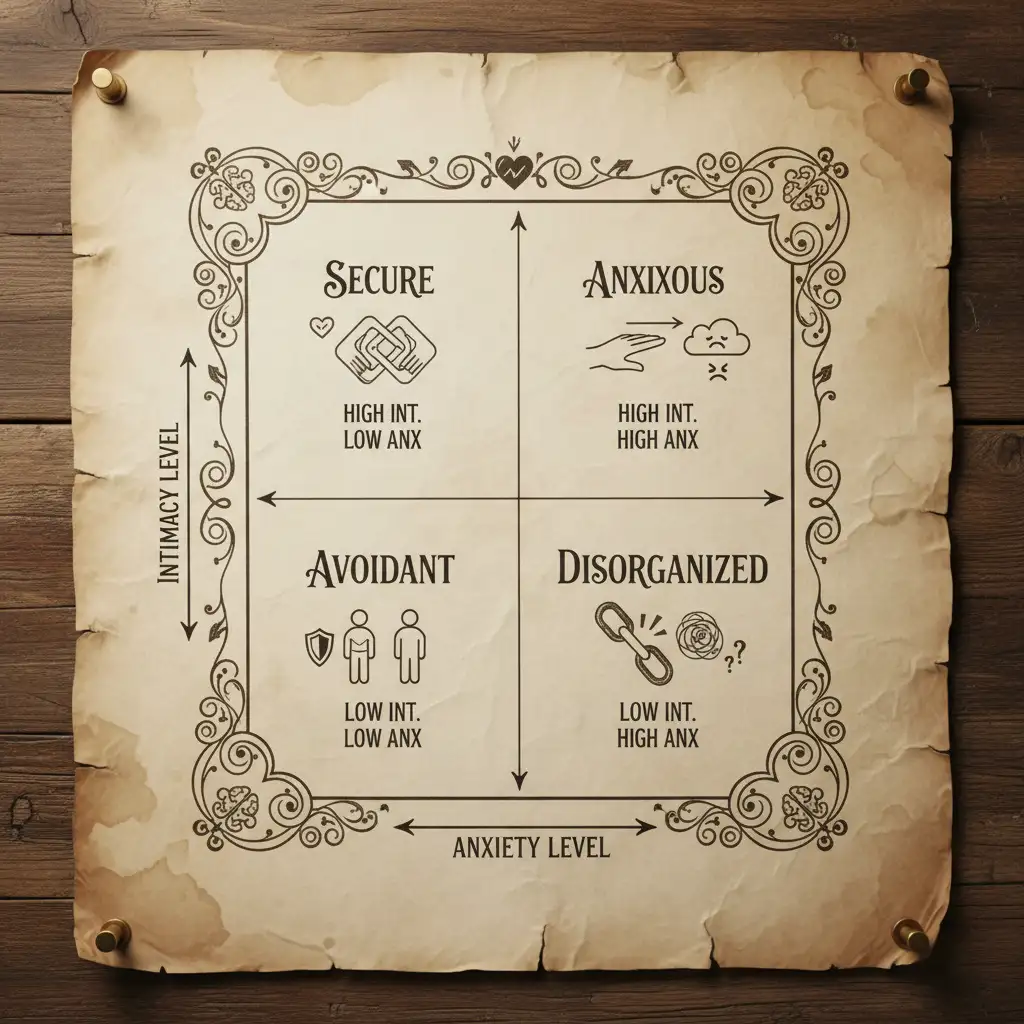
The Four Attachment Styles Detailed
Psychologists generally categorize attachment into four distinct styles. While most people have a dominant style, it is possible to exhibit traits from different styles depending on the specific relationship or life stressor.
1. Secure Attachment
Individuals with a secure attachment style make up roughly 50-60% of the population. They are comfortable with intimacy and are typically warm, loving, and trusting. They do not fear being alone, nor do they fear being engulfed by a relationship.
Key Characteristics:
- Emotional Regulation: They can self-soothe and co-regulate with a partner effectively.
- Effective Communication: They state their needs clearly without playing games or manipulating.
- Trust: They generally trust that their partner has good intentions and do not jump to negative conclusions during conflicts.
Origin: Usually stems from caregivers who were consistently responsive to the child’s distress, creating a safe haven that allowed the child to explore the world confidently.
2. Anxious-Preoccupied Attachment
People with an anxious attachment style often feel a deep hunger for emotional closeness but are plagued by the fear that their partner does not desire the same level of intimacy. They possess a “hyper-activated” attachment system, meaning their radar for threat is highly sensitive.
Key Characteristics:
- Fear of Abandonment: A pervasive worry that a partner will leave or stop loving them.
- Need for Validation: Constant reassurance is required to quell anxiety.
- Protest Behavior: When they feel disconnected, they may act out (calling excessively, trying to make the partner jealous) to re-establish a bond.
Origin: Often results from inconsistent parenting. The caregiver was sometimes warm and responsive but other times distracted or insensitive. The child learned that to get needs met, they had to “turn up the volume” on their emotional expression.
3. Dismissive-Avoidant Attachment
Those with a dismissive-avoidant style equate intimacy with a loss of independence. They tend to pull away when a relationship becomes too serious or emotional. Their attachment system is “de-activated,” meaning they suppress their attachment needs to avoid disappointment.
Key Characteristics:
- High Independence: They pride themselves on self-sufficiency and view needing others as a weakness.
- Emotional Distancing: They may shut down during conflict or use “phantom exes” to idealize past partners while devaluing current ones.
- Misreading Signals: They often perceive a partner’s normal desire for closeness as “clinginess.”
Origin: Frequently stems from caregivers who were emotionally unavailable, distant, or rejected the child’s attempts at closeness. The child learned that expressing needs led to rejection, so they stopped asking.
4. Fearful-Avoidant (Disorganized) Attachment
This is the rarest and most complex style, often referred to as Disorganized Attachment. These individuals crave intimacy but are simultaneously terrified of it. They are caught in a biological paradox: the person they want to go to for safety is also the source of their fear.
Key Characteristics:
- Volatile Behavior: They may alternate rapidly between clinging and pushing away.
- Low Self-Esteem: They often believe they are unlovable and that others are untrustworthy.
- Emotional Storms: Difficulty regulating emotions can lead to intense relationship turbulence.
Origin: This style is highly correlated with childhood trauma, abuse, or neglect. If the caregiver was frightening or frightened, the child had no organized strategy to get their needs met, resulting in a fractured sense of safety.

The Anxious-Avoidant Trap
One of the most common and painful relationship dynamics occurs when an Anxious-Preoccupied person dates a Dismissive-Avoidant person. This pairing is frequently described as the “Anxious-Avoidant Trap” or the “Push-Pull” dynamic.
Ironically, these two styles are often drawn to one another. The Anxious person is attracted to the Avoidant’s independence (which they lack), while the Avoidant is drawn to the Anxious person’s warmth (which they suppress). However, once the relationship deepens, their opposing coping mechanisms trigger a vicious cycle.
The Cycle Explained:
- The Trigger: The Avoidant partner feels the relationship is getting too close and subconsciously withdraws to regain autonomy.
- The Reaction: The Anxious partner senses this subtle withdrawal. Their hyper-activated system sounds an alarm, causing panic. They attempt to close the gap by texting, asking for reassurance, or pursuing.
- The Escalation: The Avoidant partner perceives this pursuit as controlling or overwhelming. They withdraw further to protect their space.
- The Climax: The Anxious partner becomes increasingly distressed, leading to conflict or protest behavior. The Avoidant partner may label the Anxious partner as “crazy” or “needy.”
This cycle reinforces the worst fears of both parties: the Anxious person confirms that people will leave them, and the Avoidant person confirms that relationships are suffocating. Breaking this cycle requires high levels of self-awareness and usually professional intervention.
Moving Towards Earned Security
The most hopeful aspect of attachment theory is that your style is not a life sentence. Through a process known as neuroplasticity, the brain can form new neural pathways. This process of shifting from an insecure style to a secure one is called developing “Earned Security.”
Achieving earned security involves rewiring your internal working model. This is not an overnight fix but a journey of self-discovery and intentional practice.
Strategies for Healing
1. Therapy and Professional Support:
Cognitive Behavioral Therapy (CBT), Dialectical Behavior Therapy (DBT), and specific attachment-based therapies can be incredibly effective. A therapist acts as a secure base, allowing the client to model a healthy relationship dynamic.
2. Choosing Secure Partners:
For those with insecure attachment, dating someone with a Secure attachment style is one of the fastest ways to heal. A Secure partner does not engage in the “dance” of push-pull; they provide consistency that eventually calms the insecure partner’s nervous system.
3. Emotional Regulation Techniques:
Learning to identify when your attachment system is triggered is vital. For the Anxious person, this means learning to self-soothe and wait before reacting. For the Avoidant person, this means learning to identify emotions and stay present rather than checking out.
4. Communication Scripts:
Adopting “secure” communication scripts can change relationship outcomes. Instead of acting out, one might say, “I am feeling anxious right now and I need some reassurance that we are okay,” or “I am feeling overwhelmed and need an hour to decompress, but I will come back to discuss this.”
Research from the National Institutes of Health (NIH) suggests that adult attachment styles significantly impact physical health and stress management, making the pursuit of earned security not just a relationship goal, but a general health imperative.

People Also Ask
Can your attachment style change over time?
Yes, attachment styles are plastic. Through therapy, healthy relationships, and self-work, individuals can move from insecure attachments to ‘Earned Security.’ Conversely, severe trauma in adulthood can sometimes shift a secure person toward insecurity.
What is the rarest attachment style?
The Fearful-Avoidant (or Disorganized) attachment style is considered the rarest, estimated to affect roughly 5-10% of the population. It is often associated with significant childhood trauma or abuse.
How do I know my attachment style?
You can identify your style by observing your behavior in relationships, particularly during conflict. Do you chase and panic (Anxious), withdraw and shut down (Avoidant), or communicate openly (Secure)? Validated psychological quizzes can also help.
Do avoidants ever fall in love?
Yes, avoidant individuals fall in love and desire connection. However, their defense mechanisms often cause them to suppress these feelings or push partners away when intimacy becomes too intense or threatens their independence.
Can an anxious and avoidant couple work?
Yes, but it requires significant effort. Both partners must understand their triggers. The anxious partner must learn self-soothing, and the avoidant partner must learn to tolerate intimacy and communicate their need for space respectfully.
What causes avoidant attachment?
Avoidant attachment typically stems from childhoods where caregivers were emotionally unavailable, rejected the child’s needs, or discouraged crying and emotional expression, teaching the child to rely solely on themselves.