
Family law in New Zealand encompasses the legal framework governing relationships between family members, including marriage, civil unions, de facto relationships, and especially matters concerning children. It provides pathways for resolving disputes related to parenting, guardianship, relationship property, and domestic violence, aiming to uphold the welfare of children and ensure fair processes.
Overview of the Family Court System in New Zealand
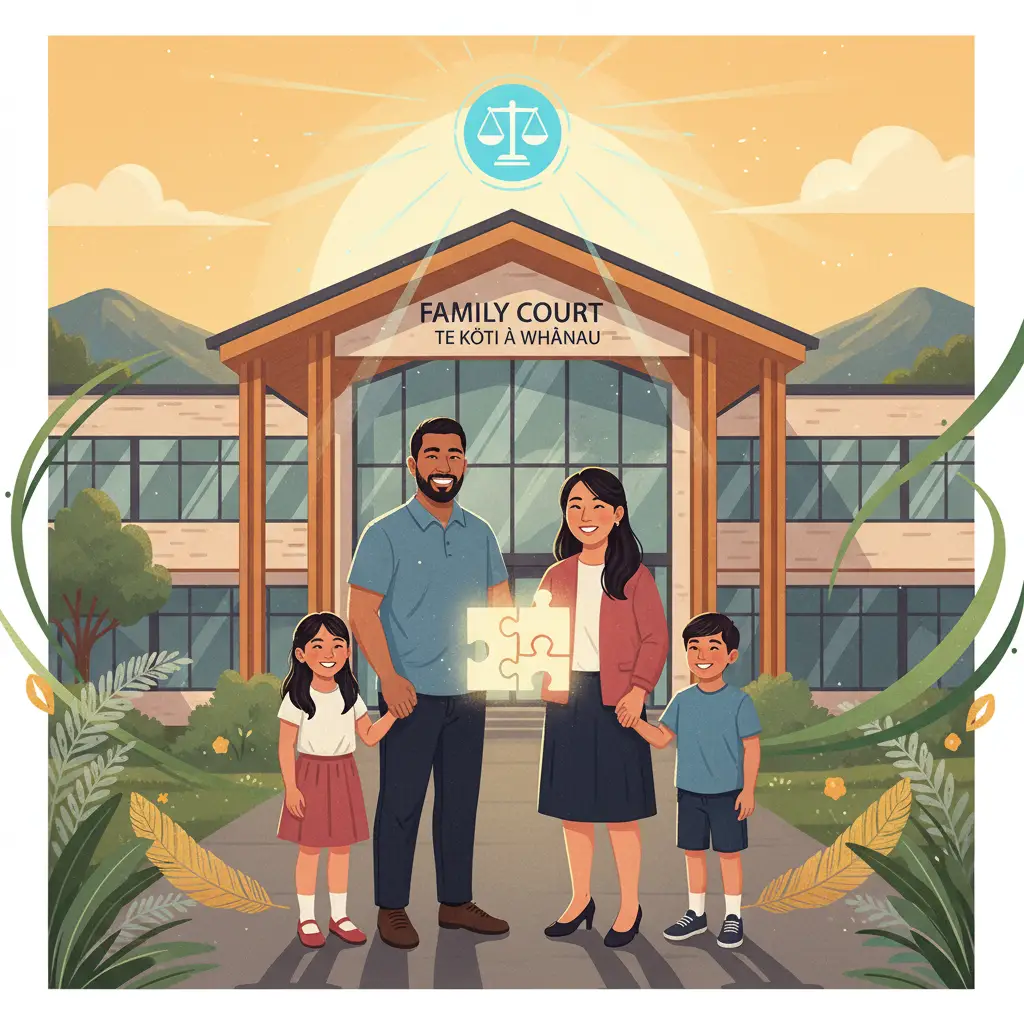
The Family Court of New Zealand plays a pivotal role in resolving disputes and making decisions on family matters, focusing primarily on the well-being and best interests of children. Established to offer a less formal and more accessible forum than the High Court, it handles a wide array of cases ranging from parenting arrangements and guardianship disputes to domestic violence orders and relationship property divisions. The court operates under a principle of promoting resolution outside of the courtroom where possible, encouraging mediation and other forms of dispute resolution before judicial intervention.
Its jurisdiction is broad, covering issues like who children live with and spend time with, guardianship responsibilities, adoption, paternity, protection orders in cases of family violence, care and protection of vulnerable children, and applications for dissolution of marriage or civil union. The Family Court aims to be a supportive environment, recognising the sensitive nature of the issues brought before it. Judges in the Family Court are specialists in family law, supported by a system that may involve lawyers for children, psychologists, and social workers to provide comprehensive assessments and advice.
A key aspect of the Family Court’s approach is its emphasis on the ‘best interests of the child,’ a paramount consideration in all decisions involving minors. This involves evaluating factors such as the child’s safety, stability, their views (where appropriate), and their relationship with both parents. The court also prioritises the principle of children having ongoing relationships with both parents unless it is not in their best interests. Understanding the structure and philosophy of the Family Court is the first step for anyone navigating family legal processes in New Zealand.
Who Works in the Family Court?
The Family Court system involves several key professionals who contribute to its function:
- Family Court Judges: These are specialist judges with expertise in family law, responsible for hearing cases, making rulings, and issuing orders.
- Lawyers for Children: Appointed by the court, these lawyers represent the child’s voice and best interests independently of their parents.
- Counsellors and Mediators: Professionals who facilitate dispute resolution processes like Family Dispute Resolution (FDR) to help parties reach agreements without judicial intervention.
- Report Writers: Psychologists, social workers, and other experts who may be appointed to provide independent reports on family dynamics or a child’s welfare to assist the court.
- Court Staff: Administrators who manage court proceedings, documentation, and provide procedural information.
Key Legislation Shaping NZ Family Law
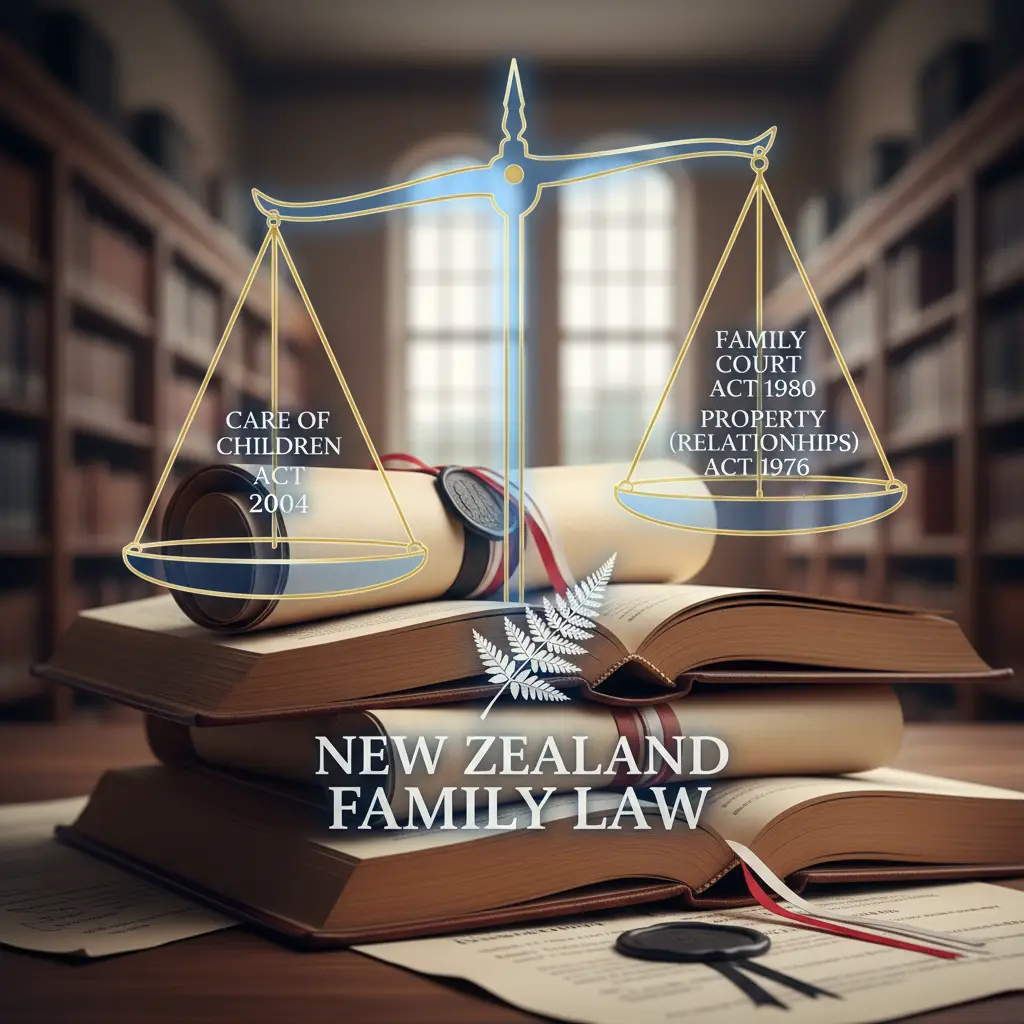
New Zealand’s family law landscape is governed by several critical statutes, each addressing specific aspects of family relationships and disputes. These acts provide the legal framework within which the Family Court operates and individuals’ rights and responsibilities are defined. A fundamental understanding of these laws is crucial for anyone involved in family legal matters.
Family Proceedings Act 1980
This Act is foundational, primarily dealing with the dissolution of marriage or civil union (what is commonly referred to as divorce). It sets out the grounds for dissolution, which in New Zealand is based on the simple premise of two years’ separation and that the marriage has broken down irreconcilably. The Act also addresses spousal maintenance, allowing for financial support to be paid from one spouse to another after separation, often to help them achieve financial independence. While it touches upon relationship property, the comprehensive division of assets is primarily covered by a separate piece of legislation.
Care of Children Act 2004
Central to matters concerning children, the Care of Children Act 2004 governs parenting arrangements, guardianship, and the care of children. It dictates how decisions are made about where children live (day-to-day care) and how often they spend time with each parent (contact). The Act enshrines the principle that a child’s welfare and best interests are the paramount consideration in all decisions. It also outlines guardianship responsibilities, which involve making important decisions about a child’s upbringing, such as their education, health, and religious upbringing. The Act encourages parents to reach their own agreements through negotiation or mediation, reserving court intervention for when an agreement cannot be reached or in cases of risk to a child’s safety.
Other Relevant Legislation
Several other acts complement these core statutes:
- Property (Relationships) Act 1976: This Act governs how relationship property (assets accumulated during a marriage, civil union, or de facto relationship) is divided upon separation or death. It generally presumes an equal sharing of relationship property, with some exceptions.
- Domestic Violence Act 1995: This Act provides protection for victims of family violence. It allows the Family Court to issue protection orders to prevent abusers from committing further violence and sets out penalties for breaches. This is a critical piece of legislation for ensuring safety within family contexts.
- Child Support Act 1991: Administered by the Inland Revenue Department (IRD), this Act establishes the framework for parents to financially support their children after separation. It sets formulas for calculating child support payments and provides mechanisms for collection and enforcement.
These legislative instruments form the backbone of family law in New Zealand, providing a clear, albeit complex, pathway for resolving family disputes and ensuring the protection and welfare of individuals, particularly children.
Mediation vs. Court: Navigating Family Disputes
When family disputes arise, particularly those involving children, New Zealand law strongly encourages parties to resolve their differences outside of the courtroom through alternative dispute resolution methods. The most prominent of these is Family Dispute Resolution (FDR). Understanding the differences and advantages of mediation versus direct court intervention is crucial for making informed decisions.
Family Dispute Resolution (FDR)
FDR is a confidential mediation process designed to help separated parents reach agreements about the care of their children. It is generally a mandatory first step for most parenting disputes before an application can be made to the Family Court, unless there are issues of urgency or family violence. FDR is facilitated by an independent, qualified mediator who helps parents communicate, identify issues, and explore potential solutions. The goal is to develop a parenting plan that outlines arrangements for day-to-day care, contact, and guardianship responsibilities.
Benefits of Mediation (FDR):
- Child-focused: Encourages parents to focus on their children’s needs and interests.
- Empowering: Allows parents to retain control over decisions affecting their family, rather than having a judge impose a decision.
- Cost-effective: Generally less expensive than full court proceedings.
- Faster: Can resolve disputes more quickly than the court system.
- Preserves Relationships: A less adversarial process can help parents maintain a cooperative relationship for co-parenting in the long term.
- Confidential: Discussions and proposed solutions in FDR are confidential and generally cannot be used as evidence in court if the mediation fails.
If an agreement is reached through FDR, it can be formalised into a consent order by the Family Court, making it legally binding.
When Court Intervention is Necessary
While FDR is highly encouraged, there are circumstances where direct application to the Family Court becomes necessary. These include:
- Failure of Mediation: If parties cannot reach an agreement through FDR, the mediator will issue a certificate allowing an application to be filed in court.
- Safety Concerns: In situations involving family violence, child abuse, or other significant safety risks, urgent applications can be made directly to the court for protection orders or interim parenting orders.
- Complex Legal Issues: Cases involving complex legal questions, such as international child abduction, significant medical decisions, or intricate guardianship disputes, may require judicial determination.
- Urgency: Where there is an immediate risk to a child’s welfare or an urgent need for a decision, an application can bypass FDR.
Applying to the Family Court involves submitting formal applications, attending court hearings, and presenting evidence. While the court aims to be less formal, it is still a legal process with strict rules and procedures. It is highly recommended to seek legal advice if you are considering applying to the Family Court. For more detailed information on Family Dispute Resolution, the New Zealand Ministry of Justice provides comprehensive resources: Ministry of Justice – Family Dispute Resolution.

Step-by-Step Guide to Dissolution of Marriage in NZ
In New Zealand, the legal term for divorce is ‘dissolution of marriage’ or ‘dissolution of civil union’. The process is relatively straightforward, provided certain criteria are met. It is important to note that a dissolution order only ends the legal status of the marriage or civil union; it does not automatically resolve issues such as relationship property division or ongoing care of children, which are typically addressed in separate proceedings.
Criteria for Dissolution
To apply for a dissolution of marriage or civil union in New Zealand, you must meet two main criteria:
- You have been living separately and apart from your spouse or partner for at least two years.
- At least one of you is domiciled in New Zealand (meaning New Zealand is considered your permanent home) or is a New Zealand citizen or is resident in New Zealand.
The two-year separation period does not necessarily mean you must have lived in separate residences for the entire time; sometimes, separation can occur while living under the same roof, provided there is clear evidence of the marriage having ended (e.g., separate finances, no shared intimacy, informing others of the separation). The court does not require proof of fault or blame from either party.
The Application Process
The application for dissolution can be made either jointly (both parties apply together) or solely (one party applies). A joint application is often simpler and signifies that both parties agree on the dissolution.
- Obtain Forms: You will need to complete specific forms, primarily Form FP 10 – Application for an Order for Dissolution of a Marriage or Civil Union. These forms are available from the Family Court or the Ministry of Justice website.
- Gather Documents: You will need your marriage certificate (or civil union certificate). If it’s not in English, you’ll need a certified translation.
- Complete the Application: Fill out the form accurately, providing details of your marriage/civil union, separation date, and confirming the two-year separation period.
- File the Application: Submit the completed forms and your marriage certificate (or a certified copy) to the Family Court. A filing fee is usually required, though fee waivers may be available for those who qualify.
- Serving the Application (for Sole Applications): If you are applying solely, you must ‘serve’ a copy of the application on your former spouse or partner. This means formally delivering the documents to them. There are specific rules about how documents must be served, often requiring a third party (like a process server) to ensure it’s done correctly and an affidavit of service is filed with the court.
- Waiting Period: After filing, there is a standard waiting period. If a joint application is filed, or if a sole application is served and no notice of opposition is filed, the court can make the dissolution order after the required period.
- Final Order: Once satisfied that all criteria are met and procedures followed, the Family Court will issue an Order for Dissolution of Marriage (or Civil Union). This order legally ends your marriage.
It is important to remember that applying for dissolution is distinct from resolving other family law matters, such as dividing relationship property or establishing parenting arrangements. These issues often require separate applications or agreements. For assistance with forms and the process, it is advisable to consult with a family lawyer or community law centre. The New Zealand Parliament website offers the full text of the Family Proceedings Act 1980 for reference: Family Proceedings Act 1980.
People Also Ask: Family Law New Zealand
What is the purpose of family law in New Zealand?
The purpose of family law in New Zealand is to provide a legal framework for resolving disputes and making decisions related to family relationships. It covers matters such as marriage, civil unions, de facto relationships, parenting arrangements, guardianship, relationship property division, and protection from family violence. The paramount consideration in all matters concerning children is their welfare and best interests.
How does the Family Court in NZ work?
The Family Court in New Zealand is a specialist court designed to resolve family disputes in a less formal setting than other courts. It handles cases like parenting orders, protection orders, adoption, and dissolution of marriage. The court aims to promote resolution outside of formal hearings where possible, often referring parties to mediation (Family Dispute Resolution) before judicial intervention. Judges are specialists in family law, and the court often involves other professionals like Lawyers for Children.
What is the difference between mediation and going to court for family matters?
Mediation, specifically Family Dispute Resolution (FDR) in NZ, is a voluntary and confidential process where an independent mediator helps parties reach an agreement themselves, especially regarding children. It’s generally faster, less costly, and less adversarial. Going to court involves a judge making decisions after formal hearings and presentations of evidence, which is more formal, often more expensive, and can be lengthier. FDR is often a mandatory step before filing certain applications in court.
What are the main laws governing family matters in New Zealand?
Key legislation governing family matters in New Zealand includes the Family Proceedings Act 1980 (dissolution of marriage, spousal maintenance), the Care of Children Act 2004 (parenting, guardianship, child care), the Property (Relationships) Act 1976 (relationship property division), the Domestic Violence Act 1995 (protection orders), and the Child Support Act 1991 (child financial support).
How do I get a divorce in New Zealand?
In New Zealand, getting a ‘divorce’ is legally referred to as applying for a ‘dissolution of marriage’ or ‘dissolution of civil union.’ To apply, you must have been living separately and apart from your spouse/partner for at least two years, and at least one party must be domiciled or resident in New Zealand. You file an application with the Family Court (either jointly or solely), provide your marriage certificate, and pay a fee. If applying solely, your spouse must be formally served with the documents.
What is Family Dispute Resolution (FDR)?
Family Dispute Resolution (FDR) is a service in New Zealand designed to help separating parents and families resolve disagreements about the care of their children. It involves a qualified mediator who assists parents in communicating and making decisions that are in the best interests of their children, aiming to create a parenting plan without needing to go to court. FDR is often a mandatory step before filing certain parenting applications with the Family Court.