
Healthy relationship conflict is a constructive interaction where partners address disagreements with mutual respect, aiming for resolution rather than victory. It involves active listening, emotional regulation, and a focus on the specific issue at hand, ultimately strengthening the bond rather than eroding trust, safety, or individual self-worth.
Understanding the Dynamics of Relationship Conflict
In the realm of interpersonal relationships and family dynamics, conflict is often viewed with trepidation. However, the absence of conflict is not necessarily a sign of a healthy partnership; in fact, total silence can sometimes indicate emotional detachment or a fear of expression. Conflict, when managed correctly, is a natural byproduct of two unique individuals attempting to merge their lives, values, and habits.
The critical distinction lies not in whether a couple argues, but in how they argue. Healthy conflict acts as a bridge to deeper understanding and intimacy, allowing partners to express needs and negotiate boundaries. Conversely, unhealthy conflict acts as a sledgehammer to the foundation of the relationship, creating cracks filled with resentment, fear, and disconnection.
For couples in New Zealand, understanding this difference is paramount. Whether navigating the stresses of the cost of living, parenting challenges, or blended family dynamics, the ability to engage in healthy relationship conflict is a skill that protects not only the partnership but also the mental well-being of any children involved. It is the difference between a relationship that evolves and one that dissolves.

Characteristics of Healthy, Constructive Arguments
Constructive conflict is characterized by a fundamental mindset: it is the couple versus the problem, not one partner versus the other. When this shift occurs, the goal changes from “winning” the argument to resolving the issue. Below are the core pillars of healthy conflict.
1. The Use of “I” Statements
Language plays a pivotal role in how a message is received. Unhealthy conflict is often riddled with accusatory “You” statements (e.g., “You always ignore me,” “You are so lazy”). These statements trigger immediate defensiveness because they attack the person’s character rather than their behavior.
In healthy conflict, partners utilize “I” statements to express their own feelings and needs without assigning blame. For example, “I feel overwhelmed when the dishes pile up because it makes the kitchen feel chaotic. I would appreciate help with clearing them.” This invites empathy rather than a counter-attack.
2. Active Listening and Validation
Hearing is a physiological process; listening is a cognitive and emotional choice. In constructive arguments, partners practice active listening. This involves giving the speaker undivided attention, not interrupting, and summarizing what was heard to ensure accuracy.
Crucially, healthy conflict involves validation. Validating a partner’s feelings does not mean you agree with their perspective or facts; it simply means you accept their emotions as real and understandable given their experience. Phrases like “I can see why that upset you” can de-escalate tension almost instantly.
3. Staying on Topic
Toxic arguments often suffer from “kitchen-sinking”—a phenomenon where a dispute about a specific issue (e.g., being late for dinner) spirals into a laundry list of past grievances dating back years. Healthy conflict remains focused on the present issue. By dealing with one problem at a time, the couple prevents the interaction from becoming an overwhelming character assassination.
4. Repair Attempts
Even in healthy arguments, tensions rise. The distinguishing factor of a strong relationship is the presence and acceptance of “repair attempts.” These are small gestures—a joke, a touch, an apology, or a smile—meant to lower the emotional temperature. In healthy dynamics, partners recognize these olive branches and accept them, rather than swatting them away.
The “Four Horsemen” of Relationship Breakdown
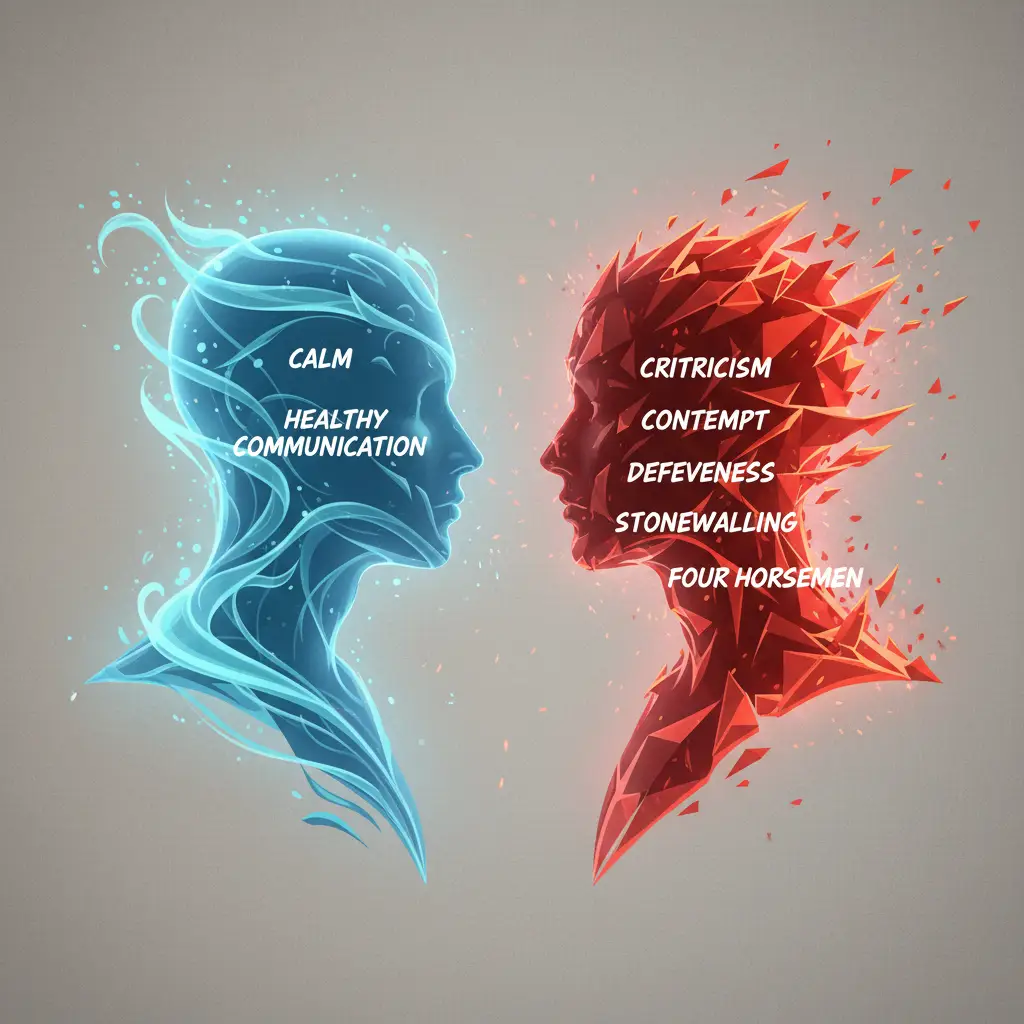
To understand healthy conflict, one must also recognize the harbingers of relationship demise. Dr. John Gottman, a renowned relationship researcher, identified four specific communication styles that can predict divorce with high accuracy. He termed these the Four Horsemen of the Apocalypse.
1. Criticism
Criticism is distinct from a complaint. A complaint focuses on a specific behavior, whereas criticism attacks the character of the partner.
Example: “You are so selfish” (Criticism) vs. “I was upset when you didn’t call” (Complaint).
The Antidote: Use a “gentle start-up” using “I” statements to express a need.
2. Contempt
Contempt is the most dangerous of the horsemen. It involves treating a partner with disrespect, ridicule, or disgust. It includes sarcasm, eye-rolling, name-calling, and mockery. Contempt assumes a position of moral superiority. In New Zealand family law contexts, severe contempt can sometimes border on psychological abuse if it systematically erodes a person’s self-worth.
The Antidote: Build a culture of appreciation and respect. Focus on describing your own feelings and needs rather than describing your partner’s faults.
3. Defensiveness
Defensiveness is a way of blaming the partner. It says, “The problem isn’t me, it’s you.” When a person is defensive, they do not take responsibility for their part in the conflict. They play the innocent victim to ward off a perceived attack.
The Antidote: Take responsibility. Even accepting a small part of the problem (“You’re right, I was late, and I should have called”) can break the cycle.
4. Stonewalling
Stonewalling occurs when the listener withdraws from the interaction, shutting down and closing themselves off from the speaker. It is often a physiological response to being flooded with emotion. The stonewaller avoids eye contact, crosses their arms, and stops responding.
The Antidote: Physiological self-soothing. Taking a break for at least 20 minutes to let the heart rate drop before returning to the discussion.
De-escalation Techniques: Stopping the Spiral
When an argument begins to veer into unhealthy territory, the ability to de-escalate is vital. De-escalation does not mean surrendering; it means pausing the hostility so that rational communication can resume. Here are proven techniques to lower the temperature.
The Strategic Timeout
In the heat of the moment, the brain’s frontal lobe (responsible for logic) can be hijacked by the amygdala (responsible for fight or flight). Once this “flooding” occurs, productive conversation is impossible. Partners should agree beforehand on a signal or phrase to call a timeout.
Rule: The person who calls the timeout must propose a time to return to the conversation (e.g., “I am getting too angry to be helpful. I need to take a walk. Let’s talk again in 30 minutes”). This prevents the other partner from feeling abandoned (stonewalled).
Grounding Techniques
If you feel your heart racing or your voice raising, utilize grounding techniques. The “5-4-3-2-1” method is effective: Identify 5 things you see, 4 you can touch, 3 you hear, 2 you can smell, and 1 you can taste. This forces the brain back into the present moment and out of the emotional spiral.
The “Do Over”
It is acceptable to stop a sentence halfway through and say, “That didn’t come out right. Can I try that again?” This requires humility but demonstrates a commitment to communicating clearly rather than hurting the other person.
When Conflict Becomes Abuse: The Red Lines
It is imperative to distinguish between unhealthy conflict and abuse. Unhealthy conflict may be immature, hurtful, or annoying, but abuse is characterized by a pattern of power and control. In the context of New Zealand relationships, recognizing these signs is critical for safety.
Signs that conflict has crossed into abuse include:
- Fear: You are afraid of your partner’s reaction or walk on eggshells constantly.
- Coercive Control: Your partner controls your finances, who you see, or where you go.
- Physical Intimidation: Blocking doorways, throwing objects, punching walls, or any physical contact.
- Gaslighting: Systematically causing you to question your own sanity or memory of events.
- Isolation: Cutting you off from whānau and friends to make you dependent on them.
Under the Family Violence Act 2018, psychological abuse is recognized as a form of family violence in New Zealand. This includes intimidation, harassment, and threats. If “conflict” involves one person holding power over the other through fear, it is not a relationship struggle to be managed; it is violence that requires intervention.
If you suspect you are in an abusive relationship, traditional couples counseling is often not recommended, as it can be dangerous. Instead, seek individual support from organizations like New Zealand Police or Women’s Refuge.
Legal Implications in New Zealand Family Law
The nature of conflict within a relationship has significant implications if the relationship ends, particularly regarding the care of children. New Zealand’s Family Court operates under the Care of Children Act 2004, where the paramount consideration is the welfare and best interests of the child.
Conflict and Parenting Orders
High-conflict parents who cannot communicate effectively may find the Family Court intervening more intrusively in their lives. If parents cannot agree on day-to-day care, the court may issue Parenting Orders. Evidence of inability to co-parent due to toxic conflict can influence these decisions.
Furthermore, if there is a history of “unhealthy conflict” that crosses the threshold into family violence (as defined by the Family Violence Act), the court may restrict contact or require supervised contact to ensure the safety of the child. The courts are increasingly recognizing that exposing children to chronic, high-conflict verbal aggression is a form of psychological harm.
Mediation and FDR
For couples separating who have experienced unhealthy but non-abusive conflict, New Zealand law encourages Family Dispute Resolution (FDR). This is a mediation process designed to help parents reach agreements without needing a judge. However, successful mediation requires the ability to engage in the constructive conflict techniques mentioned earlier: listening, compromising, and focusing on the child’s needs rather than past grievances.

Conclusion: Moving Toward Resolution
Distinguishing between healthy and unhealthy conflict is a vital life skill. Healthy conflict is a mechanism for growth, allowing couples to navigate the complexities of life in New Zealand as a united team. It requires patience, the suppression of the ego, and a genuine desire to understand the other person.
However, when conflict creates a dynamic of fear, contempt, or control, it ceases to be a relationship issue and becomes a safety issue. Recognizing the difference allows individuals to know when to fight for the relationship using de-escalation tools, and when to seek legal or professional help to exit a destructive cycle.
People Also Ask
Is it normal to fight in a healthy relationship?
Yes, conflict is normal in every relationship. The difference in a healthy relationship is that the fighting is fair, respectful, and focused on resolving the issue rather than attacking the partner’s character.
What are the main signs of toxic conflict?
Signs of toxic conflict include constant criticism, contempt (mocking or disrespect), defensiveness, stonewalling (refusing to communicate), and arguments that circle endlessly without resolution.
How can I stop being defensive during an argument?
To stop being defensive, try to listen to the validity of your partner’s complaint rather than the attack. taking responsibility for even a small part of the issue can diffuse the tension. Use “I” statements to express your feelings instead of counter-attacking.
What is the difference between conflict and abuse?
Conflict involves a disagreement between equals. Abuse involves an imbalance of power where one person uses fear, intimidation, control, or physical violence to dominate the other. Abuse is never “healthy conflict.”
Can a relationship survive the “Four Horsemen”?
Yes, but it requires effort. Couples can learn antidotes to the Four Horsemen: replacing criticism with gentle start-ups, replacing contempt with appreciation, replacing defensiveness with responsibility, and replacing stonewalling with self-soothing.
Where can I get help for relationship issues in NZ?
In New Zealand, you can access relationship counseling through private therapists, organizations like Citizens Advice Bureau for referrals, or calling 1737 for mental health support. For safety concerns, contact Shine, Women’s Refuge, or the Police.