
A joint bank account NZ is a shared financial facility offered by New Zealand banks that grants two individuals equal access to deposited funds and transaction capabilities. Primarily used by couples to manage shared liabilities like mortgages, rent, and utilities, these accounts typically carry “joint and several liability,” meaning both parties are legally responsible for any debt or overdrafts incurred, regardless of who spent the money.
Merging finances is one of the most significant milestones in a relationship. It moves a partnership from an emotional bond to a contractual economic unit. In New Zealand, where the cost of living and housing market pressures often necessitate dual incomes to get ahead, structuring your shared finances correctly is not just about convenience—it is about legal protection and relationship longevity.
Whether you are moving in together, buying your first home, or getting married, the decision to open a joint account requires transparent communication and a clear understanding of New Zealand banking laws. This guide covers everything from the mechanics of “joint and several liability” to the best apps for tracking your shared spending.
Understanding Joint Bank Accounts in New Zealand
Before visiting a branch at ANZ, ASB, BNZ, Westpac, or Kiwibank, it is vital to understand the legal framework underpinning a joint account in New Zealand. Unlike a standard individual account, a joint account creates a legal nexus between two people.
The Concept of Joint and Several Liability
The most critical concept to grasp is “joint and several liability.” In the context of New Zealand banking, this means that the bank treats the account holders as a single entity regarding debt, but as individuals regarding collection.
If your partner spends the account into a deep overdraft or accrues fees, the bank is legally entitled to pursue you for the full amount, not just half. You are liable for 100% of the debt if your partner cannot or will not pay. This applies even if the relationship ends. Therefore, trust is the currency of a joint account, not just dollars.
The Right of Survivorship
In New Zealand, joint accounts generally operate under the principle of “survivorship.” If one account holder passes away, the remaining funds usually transfer automatically to the surviving account holder. This bypasses the estate and the probate process, allowing the surviving partner immediate access to funds for funeral costs and living expenses. However, this can be contested in complex family scenarios, so it is worth discussing with a legal professional if you have children from previous relationships.

The Pros and Cons of Merging Finances
Deciding to combine financial forces is rarely black and white. While it simplifies household management, it can introduce friction regarding spending habits.
The Advantages
- Streamlined Administration: Having a single account for rent, power, internet, and groceries eliminates the “I paid this, you owe me that” spreadsheet fatigue. It simplifies life admin significantly.
- Transparency and Accountability: Shared accounts foster openness. It is harder to hide financial infidelity when both parties see the transaction history. This transparency often encourages better spending habits.
- Goal Acceleration: When two incomes are pooled towards a common goal—like a deposit for a house in Auckland or Wellington—the psychological momentum of seeing the balance grow faster can be a powerful motivator.
- Reduced Banking Fees: Maintaining one set of accounts rather than two distinct sets can sometimes reduce total monthly account fees, depending on the bank package you choose.
The Disadvantages
- Loss of Autonomy: Having to justify a purchase to a partner can feel stifling. If one partner enjoys daily coffees and the other is frugal, resentment can build quickly.
- Credit Score Linkage: If the joint account has an overdraft facility, your credit files are effectively linked. Poor financial management by one partner can negatively impact the other’s ability to secure credit in the future.
- Risk in Breakups: In a volatile separation, one partner could legally withdraw all funds from a joint account before a freeze is put in place. While the courts can rectify this later, the immediate financial hardship can be devastating.
Financial Models for Couples: Finding Your Fit
There is no single “correct” way to manage money. Most Kiwi couples utilize one of three primary models. Choosing the right one depends on your income levels, spending personalities, and stage of the relationship.
1. The “Pool-All” Method (Total Merger)
In this model, 100% of both incomes go into a single joint account. All expenses, savings, and personal spending are drawn from this pot. This is traditional and often used by long-term married couples.
- Best for: Couples with similar spending habits and high levels of trust.
- Risk: Can lead to arguments if one person feels the other is spending an unfair share of the “team” money.
2. The “Yours, Mine, and Ours” Method (The Hybrid)
This is increasingly the most popular model for modern relationships. Each partner keeps their personal bank account. They open a third, joint account into which they both deposit a set amount to cover shared bills (rent, food, utilities) and shared savings.
- Best for: Maintaining independence while sharing responsibility. You can buy that expensive gadget with your own money without guilt, provided your contribution to the joint account is paid.
- Strategy: Calculate your total household expenses, add a 10% buffer, and agree on how much each person contributes to cover this sum.
3. The “Allowance” Method
In this scenario, all income goes into a main account (often managed by the primary earner or the more financially literate partner), and each person receives a set “allowance” into their personal account for discretionary spending.
- Best for: Single-income families or situations where one partner has a history of poor financial impulse control.
- Risk: This can create a parent-child dynamic in the relationship, which is unhealthy for romantic partnerships. It requires extreme sensitivity to avoid power imbalances.
Navigating Income Disparity with Fairness
It is rare for two people to earn exactly the same salary. When one partner earns $120,000 and the other earns $50,000, splitting bills 50/50 is often mathematically unfair and can breed resentment. The lower earner may struggle to survive while the higher earner builds wealth.
Equality vs. Equity
Equality is splitting bills down the middle (50/50). Equity is splitting bills based on the ability to pay. For a healthy long-term financial strategy, equity is usually the superior approach.
The Proportional Contribution Calculation
To implement an equitable split, calculate the percentage of total household income each partner brings in.
Example Scenario:
Total Household Expenses: $4,000/month.
Partner A earns: $7,000 (70% of total income).
Partner B earns: $3,000 (30% of total income).
In a proportional split:
Partner A pays 70% of the bills ($2,800).
Partner B pays 30% of the bills ($1,200).
This ensures that both partners retain a similar percentage of their income for personal savings or spending, maintaining a balance of power within the relationship.
Digital Tools: Budgeting Apps for Kiwi Couples
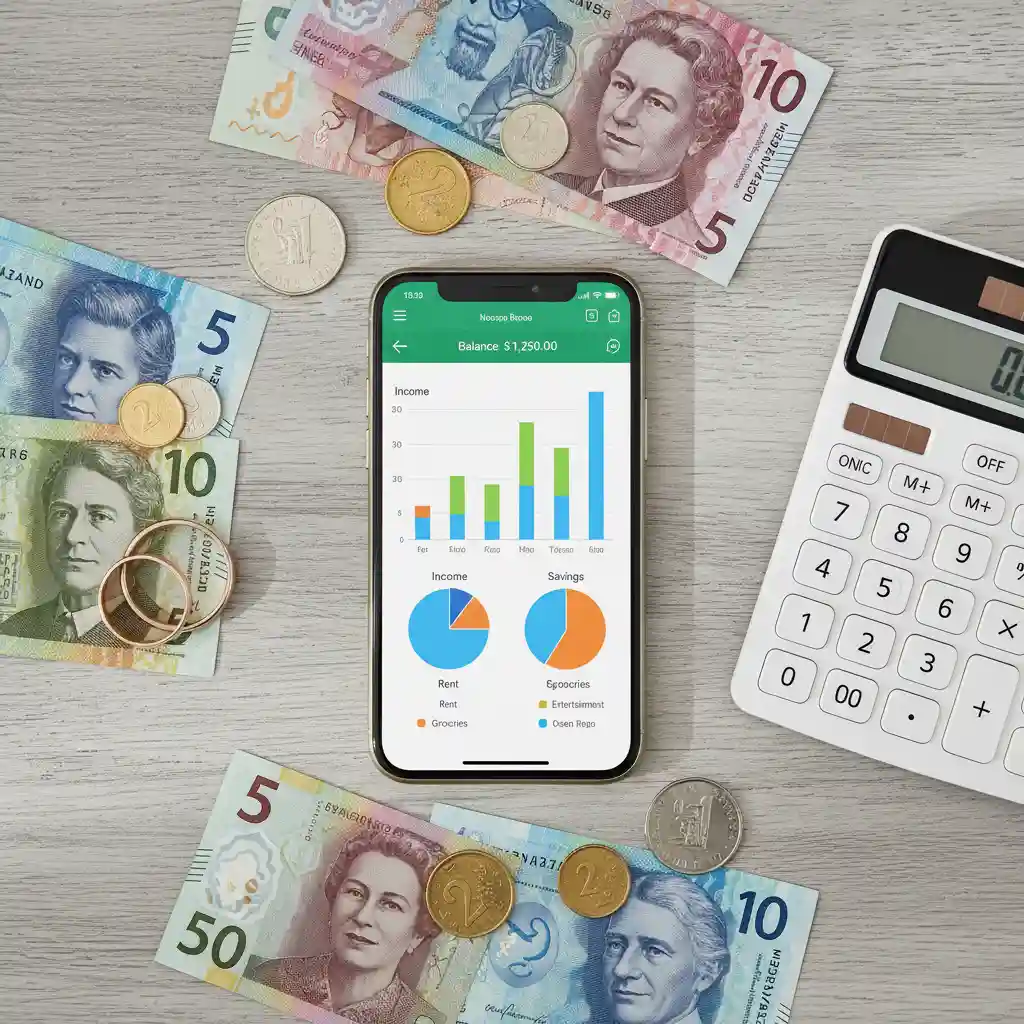
Technology has made managing joint finances significantly easier. While most NZ banking apps (like the ASB Mobile app or BNZ app) are excellent for checking balances, third-party apps offer better categorization and budgeting features.
PocketSmith
PocketSmith is a world-class budgeting tool that actually originates from Dunedin, New Zealand. It is particularly powerful for couples because it allows you to feed in bank feeds from different banks. If you have a “Yours, Mine, and Ours” setup across different institutions, PocketSmith can aggregate this data into a single dashboard. It handles multi-currency well, which is great for expats living in NZ.
Splitwise
If you choose not to open a joint account but want to share expenses, Splitwise is essential. It allows you to log bills as you go. For example, one pays the power bill, the other pays for groceries. At the end of the month, the app calculates exactly who owes whom to settle the difference. It removes the need for awkward conversations about money.
YNAB (You Need A Budget)
For couples who need strict discipline, YNAB is the gold standard. It uses a zero-based budgeting system where every dollar is given a job. It requires active participation from both partners, which forces communication and alignment on financial goals.
Legal Implications: Breakups and Relationship Property
In New Zealand, the intersection of banking and family law is governed largely by the Property (Relationships) Act 1976. This legislation is robust and often surprises couples who assume their separate savings are safe.
The 3-Year Rule
Generally, once you have been living together as a couple for three years (de facto, civil union, or marriage), all property acquired during the relationship—and often property used for the benefit of the relationship—becomes “relationship property.” This usually means it is divided 50/50 upon separation.
Money in a joint bank account is almost always considered relationship property. However, even money in a personal account can be deemed relationship property if it consists of income earned during the relationship. For authoritative details on how this act applies to your assets, you can review the legislation directly at Legislation.govt.nz.
Freezing the Account
If a relationship breaks down acrimoniously, one of the first steps a lawyer may advise is to freeze the joint bank accounts. This prevents one partner from draining the funds. Once frozen, the bank will usually require signatures from both parties to release any funds, ensuring that assets remain intact until a separation agreement is reached.
Best Practices for Opening Your Account
Ready to proceed? Follow these steps to ensure a smooth setup process with New Zealand banks.
1. Choose the Right Bank
You do not have to use the bank that one of you already uses. Shop around. Look for accounts with no monthly account fees for electronic transactions (like the ANZ Go account or ASB Streamline). Consider perks like high-interest savings rates for your emergency fund.
2. Gather Documentation
Due to Anti-Money Laundering (AML) laws in New Zealand, banks are strict about identification. Both partners must be present (or complete digital verification) and usually require:
- Proof of ID: A valid NZ Passport, overseas passport with visa, or NZ Driver Licence.
- Proof of Address: A utility bill, bank statement, or government letter dated within the last 3 to 12 months (depending on the bank) showing your name and residential address.
3. Define the Signing Authority
When opening the account, you will be asked about “signing authority.” You generally have two options:
- “Either to sign”: Either person can transact freely without the other’s permission. This is standard for everyday transaction accounts.
- “Both to sign”: Both parties must approve every transaction. This is rare for daily accounts but common for savings accounts or where trust has been compromised.
Conclusion
Opening a joint bank account in NZ is more than a logistical task; it is a commitment to a shared future. Whether you opt for a complete financial merger or a hybrid bill-splitting model, the secret to success lies in communication. Money is frequently cited as a leading cause of relationship stress, but it doesn’t have to be.
By understanding the legal implications of joint liability, utilizing modern apps to track spending, and agreeing on a fair contribution model, you can turn your finances from a source of conflict into a tool for building a prosperous life together. Start the conversation today, be transparent about your debts and goals, and choose the structure that best supports your partnership.
People Also Ask
Do both parties need to be present to open a joint account in NZ?
Yes, generally both parties must verify their identity to comply with New Zealand’s Anti-Money Laundering (AML) laws. However, many NZ banks (like ANZ, ASB, and BNZ) now allow existing customers to initiate the process online or verify ID digitally via RealMe or banking apps, though a branch visit may still be required if one party is a new customer.
Is a joint bank account split 50/50 in a divorce in NZ?
Under the Property (Relationships) Act 1976, funds in a joint bank account are typically classified as relationship property and are usually divided 50/50 upon separation, provided the couple has lived together for three years or more. This applies regardless of who deposited the money, unless a contracting out agreement (prenup) states otherwise.
Does a joint account affect my credit score in NZ?
Yes, if the joint account has an overdraft facility or is a credit account (like a joint credit card). In these cases, the account appears on both parties’ credit reports. If your partner misses payments or exceeds the limit, it will negatively impact your credit score as you are jointly and severally liable for the debt.
Can one person withdraw all money from a joint account?
If the account authority is set to “either to sign” (which is standard for everyday accounts), one person can legally withdraw all the funds without the other’s permission. While family court can later adjust for this during property settlement, the immediate loss of funds is a genuine risk.
What happens to a joint bank account when someone dies in NZ?
In most cases, the “right of survivorship” applies. This means the ownership of the account automatically passes to the surviving account holder, giving them full access to the funds. The account does not typically form part of the deceased’s estate, allowing for immediate access to money for funeral expenses.
What are the requirements to open a joint bank account in NZ?
To open a joint account, both applicants usually need to provide proof of identity (Passport or NZ Driver Licence) and proof of address (utility bill or bank statement). If you are tax residents of another country, you may also need to provide your Tax Identification Number (TIN) for that jurisdiction.


