
The Family Court in New Zealand plays a crucial role in resolving disputes and making decisions on family-related matters, particularly those involving children, family violence, and relationship breakdowns. It operates within the broader New Zealand court system, offering a specialized and confidential forum to address complex and often sensitive issues that impact individuals and families across the country.
Understanding the Family Court: Core Purpose and Principles
The Family Court is a division of the District Court in New Zealand, specifically established to handle sensitive and personal legal matters affecting families. Its primary purpose is to provide a forum for resolving disputes, making decisions in the best interests of children, and ensuring the safety and wellbeing of vulnerable family members. Unlike criminal courts, the Family Court focuses on welfare, protection, and the careful resolution of disagreements through a process designed to be less adversarial where possible, though formal hearings do occur.
Key principles guiding the Family Court’s operation include:
- Best Interests of the Child: This is the paramount consideration in all decisions concerning children. The court prioritises a child’s safety, wellbeing, and developmental needs above all else.
- Timely Resolution: The court aims to resolve matters as quickly as possible to minimise stress and uncertainty for families, particularly children.
- Protection of Vulnerable Parties: Ensuring the safety of individuals, especially victims of family violence, is a critical function, with rapid access to protection orders.
- Promotion of Agreement: The court actively encourages parties to reach their own agreements through mediation and other out-of-court dispute resolution processes before resorting to formal hearings.
- Confidentiality: Family Court proceedings are generally private, meaning the public cannot attend, and details are kept confidential to protect the privacy of those involved.
These principles underscore the court’s commitment to a child-centric and welfare-focused approach, distinguishing it from other judicial branches. The Family Court’s structure and processes are specifically tailored to address the unique complexities inherent in family relationships and their dissolution.
Jurisdiction and the Wide Range of Cases Handled
The Family Court in New Zealand possesses a broad and diverse jurisdiction, enabling it to deal with almost every aspect of family life where legal intervention is required. Its scope extends far beyond simple divorce proceedings, encompassing a wide array of civil matters that arise during relationship formation, breakdown, and the ongoing responsibilities of parenting. This wide jurisdiction ensures that families can address multiple interconnected issues within a single specialized court, promoting consistency and a holistic approach to complex situations.
Care of Children Act: Parenting and Guardianship Orders
Perhaps one of the most frequently addressed areas within the Family Court is the welfare and care of children following parental separation. The Care of Children Act 2004 governs these matters, allowing the court to make various orders, including:
- Parenting Orders: These determine who a child lives with and the contact arrangements with the other parent. The court’s primary consideration is always the child’s best interests, focusing on their safety, wellbeing, and ensuring a stable and nurturing environment.
- Guardianship Orders: Guardianship involves making important decisions about a child’s upbringing, such as their education, health, religious observance, and cultural upbringing. Parents are typically joint guardians, but if disputes arise, the court can intervene to make decisions or appoint an additional guardian.
- Relocation: If one parent wishes to move a child away from their current home, especially if it impacts the other parent’s contact, the court may need to grant permission, again prioritising the child’s best interests.
The court often encourages parents to agree on these matters through Family Dispute Resolution (FDR) before an application is made. If an agreement cannot be reached, the court will make a determination based on evidence and legal principles.
Addressing Family Violence: Protection Orders and Safety
A critical function of the Family Court is to provide immediate protection for individuals and families experiencing violence. Under the Family Violence Act 2018, the court can issue:
- Protection Orders: These are legally binding orders designed to protect victims of family violence (including physical, sexual, psychological, and economic abuse) from further harm. A Protection Order prohibits the perpetrator from engaging in various forms of contact or abusive behaviour towards the protected person(s) and any children included in the order.
- Occupation Orders: These can remove the violent party from the family home, regardless of ownership, to ensure the safety of the applicant and children.
- Tenancy Orders: These grant exclusive rights to a tenancy to the protected person.
Applications for Protection Orders can often be made ‘without notice’, meaning the order can be made urgently by a judge before the other party is informed, especially if there’s an immediate risk of harm. This immediate access to justice is vital in situations of genuine danger.
Resolving Relationship Property Disputes
When a marriage, civil union, or de facto relationship ends, the Family Court deals with the division of relationship property under the Property (Relationships) Act 1976. This typically involves:
- Equal Sharing Principle: For relationships of three years or more, the general rule is an equal (50/50) division of relationship property, which can include the family home, cars, savings, investments, and debts.
- Valuation and Distribution: The court assists in determining what constitutes relationship property, its value, and how it should be divided when parties cannot agree.
- Contracting Out Agreements: The court can also consider and enforce pre-nuptial or relationship agreements (contracting out agreements) that specify how property should be divided upon separation.
These disputes can be highly complex, involving significant assets and financial arrangements, often requiring expert valuations and detailed financial disclosures from both parties. The court aims for a fair and equitable division, recognising contributions made during the relationship.

Other Significant Jurisdictions of the Family Court
Beyond the core areas of children, violence, and property, the Family Court also handles a range of other crucial matters:
- Spousal Maintenance: In some cases, one partner may be ordered to pay financial support (spousal maintenance) to the other for a period after separation, particularly if one partner’s income earning capacity has been significantly affected by the relationship.
- Adoption: The Family Court approves all adoptions in New Zealand, ensuring they are in the best interests of the child.
- Paternity: If there is a dispute about who the father of a child is, the court can make a declaration of paternity.
- Personal Welfare and Property Rights (PPPR Act): Under the Protection of Personal and Property Rights Act 1988, the court can appoint welfare guardians or property managers for individuals who lack the mental capacity to make decisions for themselves, ensuring their wellbeing and assets are protected.
- Child Support Reviews: While the Inland Revenue Department (IRD) administers child support, the Family Court can review certain IRD decisions or make departure orders in specific circumstances.
This breadth of jurisdiction highlights the Family Court’s pivotal role in providing legal remedies and frameworks for almost every significant family transition or challenge.
Commencing Court Proceedings: Initial Steps and Applications
Initiating a case in the Family Court involves a structured process, beginning with the filing of an application. Understanding these initial steps is crucial for anyone considering legal action or responding to an application. The New Zealand Ministry of Justice provides comprehensive guidance on court processes and forms. The Ministry of Justice website is an invaluable resource for official information regarding the Family Court.
The Application Process
Proceedings typically begin when one party (the applicant) files an application form with the Family Court. The type of application will depend on the specific issue at hand (e.g., an application for a Parenting Order, a Protection Order, or to divide relationship property). These forms are available from the Family Court or online via the Ministry of Justice website.
- Filing the Application: Once completed, the application form and any supporting documents (such as affidavits, which are sworn statements of facts) are filed with the court. There may be a filing fee, though this can sometimes be waived or remitted.
- Serving Documents: After filing, the application and supporting documents must be formally ‘served’ on the other party (the respondent). This ensures the respondent is aware of the proceedings and has an opportunity to respond. Specific rules govern how documents must be served, often requiring personal delivery by a professional process server.
- Responding to an Application: The respondent has a limited time frame (usually 14 or 21 days, depending on the type of application) to file a ‘notice of response’ or a ‘counter-application’ outlining their position and any counter-proposals.
Without Notice vs. On Notice Applications
Most applications are filed ‘on notice’, meaning the other party is informed and has the opportunity to respond before any substantive court orders are made. However, in urgent situations, especially those involving immediate safety concerns, an application can be made ‘without notice’.
- Without Notice Applications: These allow a judge to make an interim order quickly, often within hours or a few days, without the respondent first being informed. This is common for Protection Orders in cases of family violence, where immediate action is required to ensure safety. The respondent will then be served with the application and the interim order and will have an opportunity to challenge it at a later hearing.
- On Notice Applications: These are the standard process, where both parties are given notice and an opportunity to present their case before any orders are made.
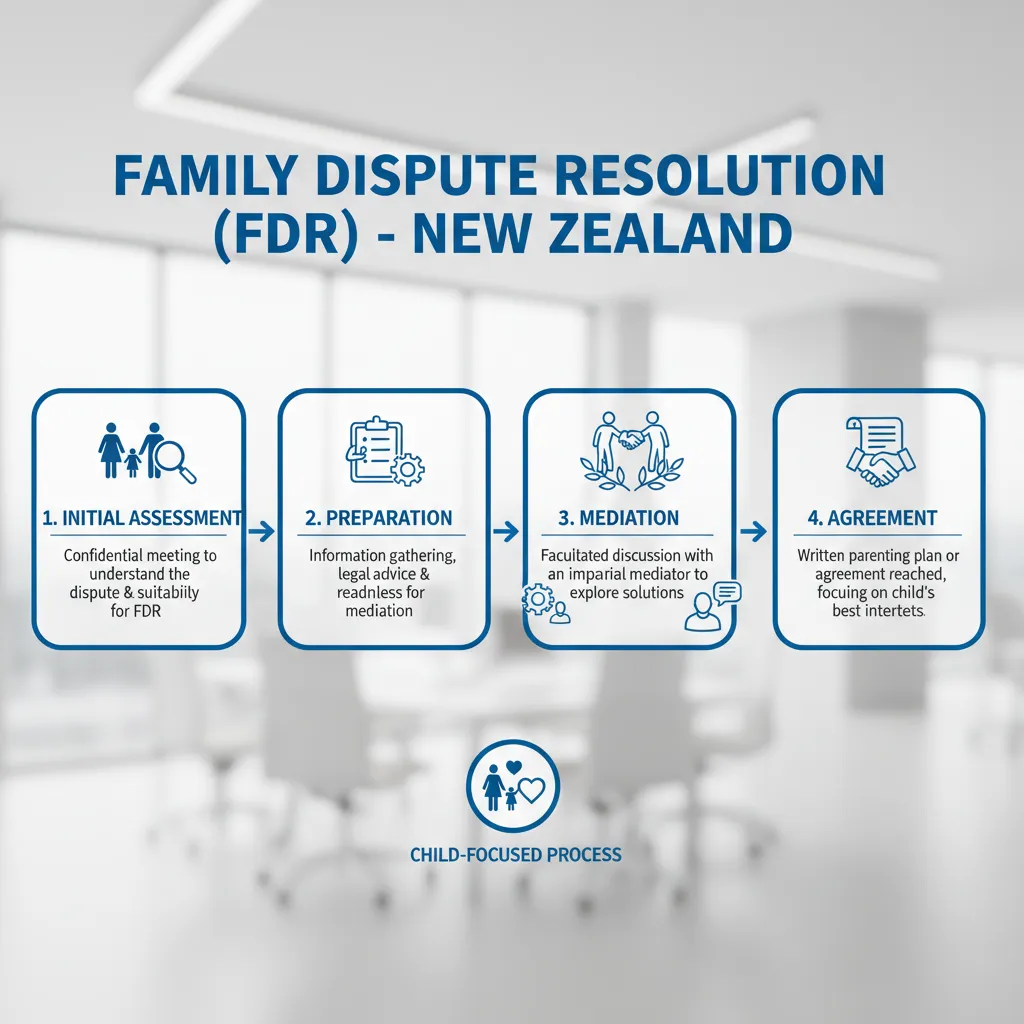
The Emphasis on Out-of-Court Resolution: FDR and Mediation
The Family Court strongly advocates for parties to resolve their disputes outside of a formal court hearing whenever possible. This approach aims to reduce conflict, empower families to make their own decisions, and achieve more sustainable agreements. The primary mechanism for this is Family Dispute Resolution (FDR).
Family Dispute Resolution (FDR)
For most applications relating to the care of children, parties are required to attempt FDR before they can apply to the Family Court for a Parenting Order. FDR is a confidential mediation service provided by accredited mediators. Its goal is to help parents reach an agreement on who their children live with and the contact arrangements with each parent.
- Process: FDR involves an initial assessment to determine suitability, followed by joint mediation sessions (if appropriate) where parents, with the help of a neutral mediator, discuss their disagreements and try to find common ground.
- Benefits: FDR is often quicker, less stressful, and less expensive than going to court. Agreements reached through FDR are often more durable because the parents have been directly involved in creating them.
- Exemptions: There are some exemptions to the requirement for FDR, particularly in cases involving urgency, family violence, or child abuse, where direct negotiation would be unsafe or inappropriate.
Other Forms of Mediation and Negotiation
While FDR is specific to care of children matters, other forms of mediation and direct negotiation are encouraged for all types of family disputes, including relationship property. Lawyers often play a key role in facilitating these negotiations, helping their clients understand their rights, obligations, and the potential outcomes of going to court, thus encouraging settlement. Reaching an agreement outside of court allows parties more control over the outcome and can preserve relationships more effectively than an adversarial court battle.
Key Roles and Personnel Within the Family Court System
Navigating the Family Court involves interacting with various professionals, each playing a distinct and crucial role in the administration of justice and the support of families. Understanding who these people are and their functions can demystify the court process.
- Family Court Judges: Judges are at the heart of the court system. They hear evidence, interpret the law, and make decisions or issue orders. Family Court Judges are specially appointed due to their expertise in family law and their ability to handle sensitive matters with compassion and legal rigor.
- Lawyers for Parties: Most parties are represented by lawyers. A lawyer advocates for their client’s best interests, provides legal advice, prepares court documents, and represents them in hearings. Legal aid may be available for eligible individuals.
- Lawyers for Children: In many cases involving children, a ‘lawyer for the child’ is appointed by the court. This lawyer’s role is unique: they represent the child’s interests, which may not always align with either parent’s wishes. They meet with the child, attend court, and present the child’s views and their professional assessment of the child’s best interests to the judge. This ensures the child’s voice is heard independently.
- Counsel to Assist the Court: Occasionally, a counsel to assist the court may be appointed. Their role is to provide independent legal analysis on complex issues, research points of law, or gather further evidence to aid the judge in making a decision.
- Counsellors and Specialists: The court can direct parties to attend counselling or can appoint various specialists, such as psychologists or social workers, to assess families or children and provide expert reports. These reports often provide crucial insights into a child’s needs or family dynamics, assisting the judge in decision-making.
- Family Court Coordinators and Registrars: These administrative staff manage the court’s operations, including processing applications, scheduling hearings, and providing information about court procedures (though not legal advice).
The collaborative efforts of these professionals aim to ensure that cases are handled efficiently, fairly, and with the utmost consideration for the wellbeing of all family members, especially children. For further detailed information, a resource like Community Law Aotearoa’s manual can offer excellent insights into the court system and legal aid options.
Court Hearings, Interim Orders, and Final Judgments
If out-of-court resolution is unsuccessful, or if the nature of the case requires immediate judicial intervention, the matter will proceed to court hearings. The court process is designed to gather information, hear arguments, and ultimately result in legally binding decisions.
Types of Hearings
- Callovers and Directions Conferences: These are initial administrative hearings where the judge reviews the progress of a case, identifies outstanding issues, and gives ‘directions’ (instructions) to the parties on what steps need to be taken next, such as filing further documents, attending counselling, or preparing for a substantive hearing.
- Interim Hearings: These hearings deal with urgent matters or allow the judge to make temporary orders (interim orders) that will remain in place until a final decision can be made. For example, an interim Parenting Order might set out temporary living arrangements for children.
- Substantive Hearings (Defended Hearings): This is where the core issues in dispute are heard. Both parties present their evidence, call witnesses, and make legal arguments. The judge listens to all evidence and arguments before making a final decision. These hearings can range from a few hours to several days, depending on the complexity of the case.
The Role of Evidence and Affidavits
Evidence in the Family Court is typically presented through ‘affidavits’, which are written statements of facts sworn or affirmed to be true. Witnesses may also give oral evidence and be cross-examined by the opposing party’s lawyer. The judge will consider all the evidence presented to make findings of fact and apply the relevant law.
Judgments and Orders
Following a substantive hearing, the judge will issue a ‘judgment’ explaining their decision and the reasons behind it. This judgment will often be followed by a ‘final order’ which is a legally binding document outlining what the parties must do or not do. These orders can cover anything within the court’s jurisdiction, from specific contact arrangements for children to the division of property or the terms of a Protection Order.
All parties must adhere to court orders. Failure to comply can result in enforcement action, which may include further court proceedings, fines, or even imprisonment in serious cases of contempt of court.
Appeals and Reviews of Family Court Decisions
While Family Court decisions are intended to be final, avenues exist for parties to challenge a decision if they believe an error of law or fact has occurred. This provides an important safeguard within the judicial system.
- Appeals to the High Court: Decisions made by a Family Court Judge can generally be appealed to the High Court. An appeal usually focuses on whether the Family Court Judge made an error in applying the law or in their interpretation of the evidence. It is not an opportunity to simply re-argue the case. Strict time limits apply for filing an appeal.
- Applications for Rehearing: In limited circumstances, a party may apply to the Family Court itself for a ‘rehearing’ of an interim order if new evidence has emerged or if there was a procedural unfairness. This is distinct from an appeal, which goes to a higher court.
- Reviews of Registrars’ Decisions: Minor procedural decisions made by a Family Court Registrar can be reviewed by a Family Court Judge.
Engaging in an appeal or rehearing is a complex legal process that typically requires the assistance of a lawyer. The ability to appeal ensures accountability within the judicial system and offers a mechanism for correcting errors, although it is not a routine part of every Family Court case.

The Family Court in New Zealand serves as an essential institution for navigating the legal complexities of family life. From safeguarding children and protecting individuals from violence to facilitating the equitable division of property, its role is multifaceted and deeply impactful. By understanding its purpose, the types of cases it handles, and the procedures involved, individuals can better engage with this critical legal system, whether seeking assistance or responding to proceedings. The emphasis on resolution, welfare, and justice underscores its commitment to the wellbeing of New Zealand families.
People Also Ask
What is the main role of the Family Court in NZ?
The main role of the Family Court in New Zealand is to resolve disputes and make decisions on sensitive family-related matters, including issues concerning children’s care and guardianship, family violence protection, and the division of relationship property after a separation. Its primary focus is on ensuring the safety and wellbeing of vulnerable family members and acting in the best interests of children.
Do I need a lawyer to go to Family Court in NZ?
While you are not legally required to have a lawyer in the Family Court, it is highly recommended. Family law is complex, and a lawyer can provide expert advice, prepare legal documents, represent your interests in court, and help you navigate the procedures effectively. For matters involving children, a ‘lawyer for the child’ may also be appointed by the court to represent the child’s independent interests.
What is Family Dispute Resolution (FDR)?
Family Dispute Resolution (FDR) is a mediation service in New Zealand designed to help separating parents resolve disagreements about the care of their children without going to court. It involves an accredited mediator who assists parents in discussing their issues and reaching mutually acceptable agreements, aiming for less conflictual and more sustainable solutions.
How long does a Family Court case take in New Zealand?
The duration of a Family Court case in New Zealand varies significantly depending on its complexity, the cooperation between parties, and the specific issues involved. Simple matters or those settled through mediation can be resolved in weeks or a few months. Highly contested cases, especially those involving multiple hearings or specialist reports, can take many months or even over a year to reach a final resolution.
What types of orders can the Family Court make regarding children?
The Family Court can make various orders concerning children under the Care of Children Act 2004. These include Parenting Orders (determining who a child lives with and contact arrangements), Guardianship Orders (for significant decisions about a child’s upbringing like education or health), and orders related to a child’s relocation, all primarily guided by the child’s best interests.
Is the Family Court open to the public in New Zealand?
No, Family Court proceedings in New Zealand are generally not open to the public. They are kept private and confidential to protect the privacy and sensitive information of the individuals and families involved, particularly children. Only the parties directly involved, their legal representatives, court staff, and sometimes court-appointed specialists are permitted to attend hearings.