
Dunbar’s number explained refers to the theoretical cognitive limit on the number of stable social relationships a single human can maintain, typically quantified as approximately 150 individuals. First proposed by British anthropologist Robin Dunbar in the 1990s, the theory posits that the size of the neocortex restricts our capacity to process the emotional complexity and social data required to sustain meaningful bonds beyond this threshold.
The Origins: Primate Brains and Social Groups
To truly understand your social capacity, one must look back at the evolutionary biology that shaped the human brain. Robin Dunbar, an anthropologist and evolutionary psychologist at the University of Oxford, originally formulated this hypothesis while studying non-human primates. He observed a distinct correlation between the size of a primate’s neocortex—the part of the brain responsible for conscious thought and language—and the size of the social groups they formed.
Dunbar noticed that primates with larger neocortices tended to live in larger, more complex social groups. By extrapolating this data to humans based on our brain size, he calculated that the natural group size for humans should be roughly 147.8, which is rounded up to 150. This figure represents the number of people you would not feel embarrassed joining for a drink if you bumped into them at a bar; they are people you know, and who know you.
Historically, this number appears frequently in human organization. Neolithic farming villages, Roman military units (the maniple), and modern Hutterite settlements all tend to cluster around the 150 mark. When groups exceed this number, social cohesion often breaks down, requiring formal hierarchies and policing to maintain order.

The Four Circles of Intimacy
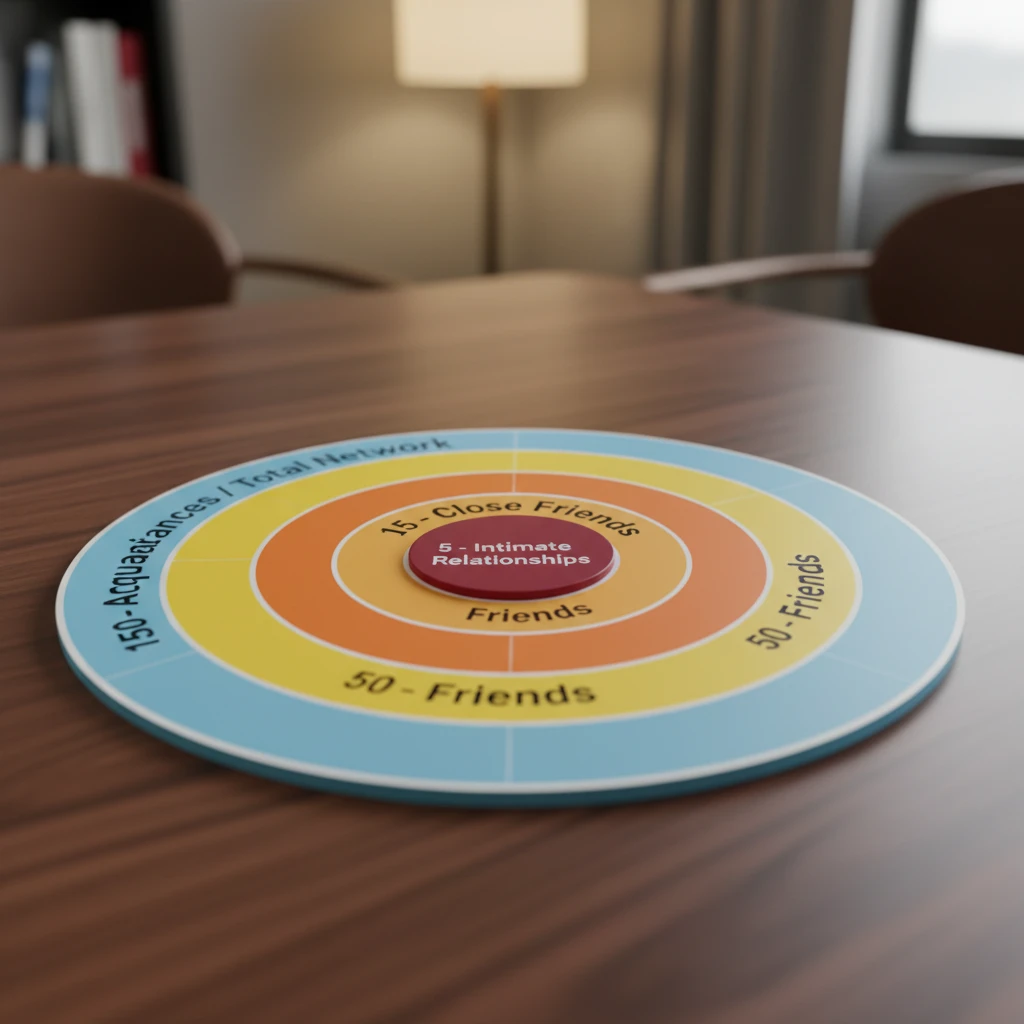
While 150 is the “headline” figure, Dunbar’s research reveals that our social network is not a flat list of acquaintances. Instead, it is structured in concentric circles of intimacy, often adhering to a “rule of three” where each layer is roughly three times larger than the one inside it. Understanding these layers is crucial for managing your emotional energy effectively.
The Support Clique (The Inner 5)
The innermost circle consists of approximately 3 to 5 people. These are your closest loved ones—spouses, best friends, or immediate family members. In times of severe emotional distress or financial crisis, these are the people you turn to first. This layer requires the most significant investment of time and emotional capital, often consuming up to 40% of your total social time budget.
The Sympathy Group (The Core 15)
Expanding outward, the next layer contains about 12 to 15 people (inclusive of the inner 5). This group represents your close friends. While you might not contact them daily, you see them frequently—perhaps monthly—and their death would leave a significant psychological void in your life. This circle is often referred to as the “sympathy group” because they are the ones you rely on for general social support.
The Affinity Group (The Circle of 50)
The third layer encompasses roughly 50 individuals. These are friends you might invite to a large dinner party or a birthday barbecue. You consider them friends, not just acquaintances, but you generally do not share your deepest secrets or financial troubles with them. Interaction here is less frequent, but the relationship is still maintained through occasional contact.
The Active Network (The 150)
Finally, we reach the limit of 150. This includes the previous circles plus casual friends and colleagues. Beyond this number, people fall into the category of “acquaintances” (around 500) and “faces we recognize” (around 1,500). The 150 limit is defined by the ability to know who the person is and how they relate to everyone else in the group. Once you cross this threshold, keeping track of the dynamic relationships between third parties becomes cognitively impossible.
The Neuroscience Behind the Limit
Why exactly does the brain hit a wall at 150? The limitation is not just about memory capacity—it is about social computing power. Maintaining a relationship requires more than just remembering a face and a name. It involves understanding the unique personality of that individual, their history with you, and, crucially, their relationships with others in your network.
This concept is known as “Theory of Mind,” the ability to attribute mental states to oneself and others. To navigate a social group effectively, you must understand second, third, and fourth-order relationships (e.g., “I know that John knows that Mary dislikes Steve”). The computational load increases exponentially with every new member added to the group.
Furthermore, relationships require time. Dunbar argues that we have a finite “time budget” for socialization. Because the quality of a relationship is directly correlated with the time invested in it, we physically cannot maintain deep connections with more than a handful of people. For more detailed biological context, you can read about the Neocortex on Wikipedia, which explains the structural basis for these cognitive limits.
Dunbar’s Number in the Age of Social Media
In the era of Facebook, LinkedIn, and Instagram, it is common to see user profiles with 500, 1,000, or even 5,000 “friends.” This phenomenon leads many to question: Has technology rendered Dunbar’s number obsolete?
The short answer is no. While social media allows us to maintain a “passive awareness” of a larger number of people, it does not increase the number of meaningful relationships our brains can handle. Research conducted by Dunbar and others on social media usage patterns suggests that even among power users, the number of active, reciprocal interactions remains remarkably close to 150.
Digital tools function as a Rolodex, allowing us to store contact information and life updates for acquaintances (the 500 or 1,500 layers) without the relationship decaying as quickly as it would offline. However, these connections often lack the intimacy and trust required for the inner circles. We may “know” more people, but our core social capacity remains biologically hardwired.
Applying Dunbar’s Number to Your Life and Business
Understanding these cognitive limits can be transformative for personal well-being and professional organization. By acknowledging that you cannot be everything to everyone, you can start to prioritize quality over quantity.
Pruning Your Social Network
If you feel socially overwhelmed, it may be because you are trying to squeeze too many people into your inner circles. Use the concept of the “5” and “15” to audit your relationships. Are you investing your limited time in the people who truly matter to you? It is healthy to allow some relationships to drift into the outer circles to make room for those that provide genuine support and joy.
Organizational Structure
In the business world, Dunbar’s number is a powerful metric for organizational design. Companies like W.L. Gore and Associates (makers of Gore-Tex) famously limit their factory sizes to 150 employees. They found that once a facility exceeds this number, the sense of community dissolves, and bureaucracy takes over. By splitting units when they reach 150, organizations can maintain a “family” feel where peer pressure, rather than strict management, ensures high performance.

Criticism and Modern Re-evaluations
While Dunbar’s number is a widely accepted concept in evolutionary psychology, it is not without its critics. Some researchers argue that the number is not a hard cap but a flexible range, influenced by personality traits like extraversion. For instance, highly extroverted individuals might be able to maintain a slightly larger active network than introverts, though the quality of those connections may vary.
Additionally, recent studies have challenged the precision of the 150 figure. A study published by researchers at Stockholm University suggested that the confidence intervals for predicting group size based on brain size are much larger than Dunbar initially proposed. However, even critics generally agree on the fundamental premise: human social capacity is finite. For a deeper dive into the academic perspective, resources from the National Center for Biotechnology Information (NCBI) often host papers discussing the social brain hypothesis.
Conclusion
Dunbar’s number serves as a vital reminder of our biological humanity in an increasingly digital world. While we may strive to expand our networks infinitely, our brains prefer depth and stability. By respecting the limit of 150, we can curate a social life that is manageable, meaningful, and psychologically rewarding. Whether you are managing a team or managing your friendships, remembering the circles of intimacy ensures that you invest your energy where it yields the highest return.
People Also Ask
Is Dunbar’s number still relevant today?
Yes, Dunbar’s number remains relevant. Despite the advent of social media, studies indicate that the number of meaningful, reciprocal relationships humans maintain online still hovers around 150. Technology extends our reach to acquaintances but does not expand the cognitive capacity for deep bonding.
Can you have more than 150 friends?
You can have more than 150 acquaintances or “Facebook friends,” but it is cognitively difficult to maintain more than 150 stable, active relationships. Beyond this number, relationships tend to degrade into loose ties because the brain cannot track the social dynamics effectively.
What are the 4 layers of Dunbar’s number?
The four main layers of intimacy are the Support Clique (approx. 5 people), the Sympathy Group (approx. 15 people), the Affinity Group (approx. 50 people), and the Active Network (approx. 150 people). Each layer represents a decrease in emotional closeness and frequency of contact.
How does social media affect Dunbar’s number?
Social media allows us to maintain a “passive” memory of people in the outer layers (500+), preventing relationships from completely fading. However, it does not increase the size of the core groups (5, 15, or 150) because the time and emotional investment required for those bonds cannot be automated.
Who invented Dunbar’s number?
Dunbar’s number was proposed by British anthropologist and evolutionary psychologist Robin Dunbar in the 1990s. He formulated the theory while studying the correlation between neocortex size and social group sizes in primates.
What is the limit of the human brain for relationships?
The theoretical limit for stable social relationships is roughly 150. However, humans can recognize faces and names for up to 1,500 people, and maintain loose acquaintance ties with around 500 people, though these lack the stability and trust of the core 150.