
Conflict resolution in marriage is the strategic process by which couples navigate disagreements to reach mutual understanding without damaging their emotional bond. Effective resolution relies on “fair fighting” rules, emotional regulation, and active listening to transform inevitable disputes into opportunities for growth, ensuring that the relationship remains the priority over winning the argument.
The Psychology of Marital Conflict: Why It Is Normal
Many couples operate under the misconception that a happy marriage is defined by the absence of conflict. However, relationship experts and psychologists agree that conflict is not only inevitable but healthy in a long-term partnership. Two distinct individuals with unique backgrounds, values, and temperaments will naturally encounter friction. The health of a marriage is not measured by how often you fight, but by how you fight and how you repair the relationship afterward.
Conflict often signals that a change is needed or that a boundary has been crossed. When viewed through this lens, disagreements become a diagnostic tool for the relationship rather than a sign of failure. Avoiding conflict entirely—often called “stonewalling” or emotional withdrawal—can be far more damaging than a heated debate, as it leads to resentment and emotional distance. Successful conflict resolution in marriage requires shifting the goal from “winning” the argument to understanding your partner’s perspective.

The “Fair Fighting” Rules Every Couple Must Know
To navigate disagreements constructively, couples must agree to a set of engagement rules before an argument begins. These “fair fighting” guidelines prevent emotional injury and keep the conversation focused on resolution.
1. Eliminate “Always” and “Never”
Absolute statements such as “You never help with the kids” or “You are always late” are rarely factually accurate and almost always trigger defensiveness. These words shift the focus from the specific behavior to a character assassination. Instead, focus on the specific instance at hand. For example, “I felt overwhelmed when the laundry wasn’t done this morning” is a solvable specific issue, whereas “You are lazy” is a generalized attack.
2. Stick to One Issue at a Time
A common pitfall in marital arguments is “kitchen-sinking”—dragging up past grievances to bolster a current complaint. If you are arguing about finances, do not bring up the in-laws or household chores. Resolving one issue is difficult enough; trying to resolve five distinct problems simultaneously is impossible and leads to overwhelm.
3. No Character Assassinations
There is a profound difference between a complaint and criticism. A complaint addresses a specific action (e.g., “You didn’t put gas in the car”), while criticism attacks the partner’s character (e.g., “You are irresponsible”). Name-calling, eye-rolling, and mocking are forms of contempt that erode the foundation of respect in a marriage.
De-escalation Techniques for Heated Moments
Even with the best intentions, emotions can flare. Physiologically, when a person becomes flooded with anger, their heart rate exceeds 100 beats per minute, and their ability to process logic diminishes. This is the “fight or flight” response. At this stage, productive conversation is impossible, and de-escalation becomes necessary.
The Strategic Time-Out
Taking a break is one of the most effective tools for conflict resolution in marriage. However, it must be done correctly to avoid making the other partner feel abandoned. Establish a signal or a phrase, such as “I am feeling flooded and need twenty minutes to cool down.” Crucially, you must promise to return to the conversation. This distinguishes a healthy time-out from stonewalling.
Self-Soothing and Regulation
During the time-out, engage in self-soothing activities rather than ruminating on the argument. Go for a walk, practice deep breathing, or read a book. The goal is to lower your physiological arousal so you can return to the discussion with a functioning prefrontal cortex—the part of the brain responsible for logic and empathy.

Communication Mastery: Moving Beyond the Argument
Once emotions have settled, the work of resolution begins. This requires advanced communication skills that validate both partners’ experiences.
Use “I” Statements
“You” statements sound like accusations (e.g., “You made me angry”). “I” statements take responsibility for your own feelings and describe your experience (e.g., “I feel undervalued when I come home to a messy kitchen”). This subtle grammatical shift significantly reduces defensiveness and invites empathy.
The Speaker-Listener Technique
In this structured approach, the speaker holds the floor and expresses their feelings briefly. The listener must then paraphrase what they heard without rebutting or defending themselves. For example, “What I hear you saying is that you feel anxious when we don’t have a budget plan.” The speaker confirms if the interpretation is correct. This ensures that the partner feels heard before any problem-solving occurs.
According to the American Psychological Association, effective communication is a learnable skill that serves as the primary predictor of marital success. Couples who practice active listening report higher levels of intimacy and lower levels of stress.
Identifying the Four Horsemen of Divorce
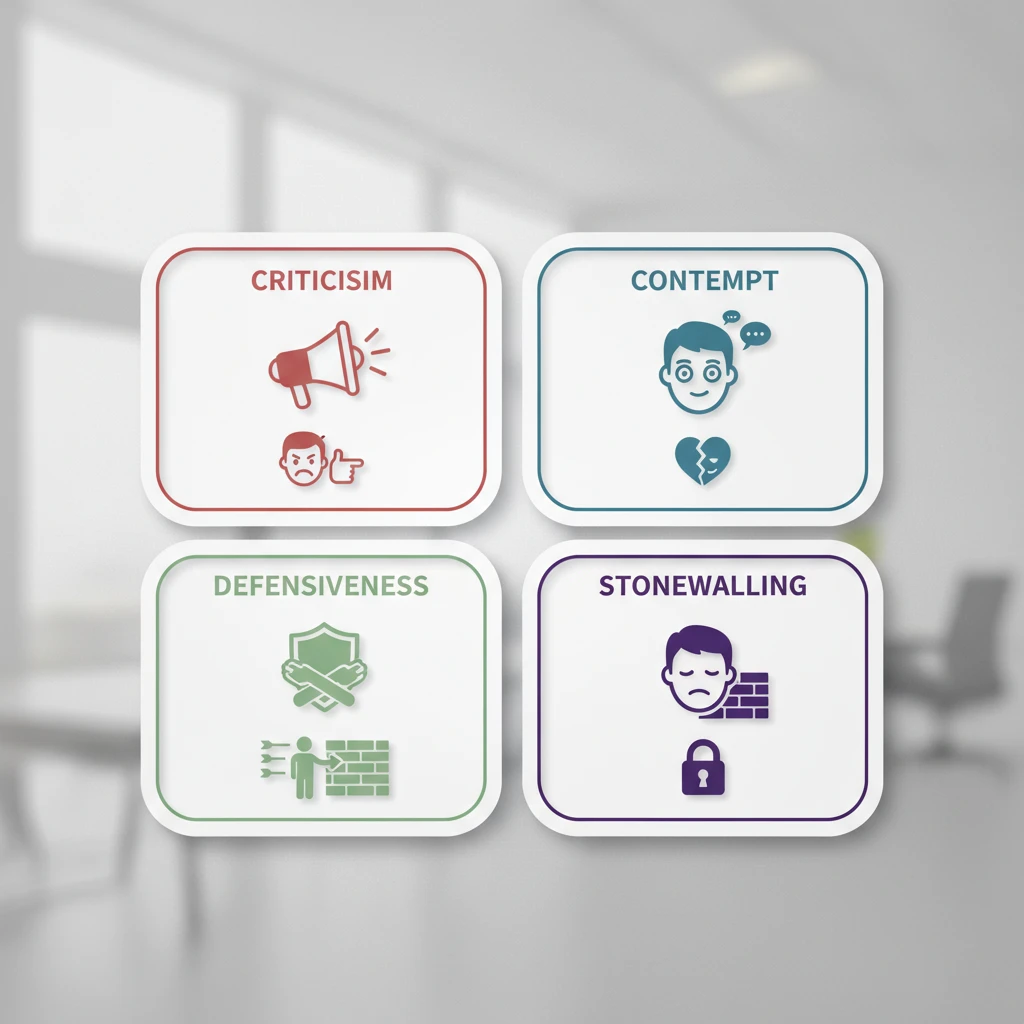
Renowned relationship researcher Dr. John Gottman identified four specific communication styles that can predict divorce with over 90% accuracy. Recognizing these “Four Horsemen” is critical for conflict resolution in marriage.
- Criticism: Attacking your partner’s character rather than their behavior.
- Contempt: Treating your partner with disrespect, sarcasm, or mockery. This is the single greatest predictor of divorce.
- Defensiveness: Self-protection in the form of righteous indignation or playing the victim to ward off a perceived attack.
- Stonewalling: Withdrawing from the interaction, shutting down, and closing off from the partner.
The antidote to these behaviors involves building a culture of appreciation. Regularly expressing gratitude and focusing on your partner’s positive traits creates an “emotional bank account” that can cushion the relationship during times of conflict.
When to Seek Professional Counseling
While many conflicts can be resolved at home using the strategies outlined above, some issues require professional intervention. Seeking help is not a sign of weakness but a proactive step toward preserving the marriage.
Signs You Need a Therapist
If your arguments revolve around the same unresolved issues for years, if there is a lack of intimacy, or if one partner has checked out of the relationship emotionally, it is time to seek a licensed Marriage and Family Therapist (LMFT). Additionally, if there is any history of trauma, addiction, or infidelity, professional guidance is mandatory to navigate the complex healing process safely.
Therapy provides a neutral ground where a third party can identify negative cycles and facilitate communication that might be impossible to achieve alone. For more resources on finding a qualified professional, organizations like the American Association for Marriage and Family Therapy offer directories and educational materials for couples.
People Also Ask (FAQs)
What are the 5 conflict resolution strategies in marriage?
The five common strategies are avoiding (ignoring the issue), accommodating (giving in to the other), competing (trying to win), compromising (finding a middle ground), and collaborating (working together for a win-win solution). Collaborating is generally considered the healthiest approach for long-term marital satisfaction.
How do you resolve conflict when your spouse won’t talk?
If a spouse is stonewalling, give them space but set a time to return to the conversation. Approach them gently without accusation, using “I” statements to express your need for connection. If the silence persists, professional counseling may be needed to break the pattern of withdrawal.
What is the silent treatment in marriage?
The silent treatment is a refusal to communicate verbally and electronically with one’s spouse. It is often used as a manipulation tactic or punishment and is considered a form of emotional abuse. It differs from a “time-out,” which is a mutually agreed-upon break to cool down.
How can I stop fighting with my husband constantly?
To stop constant fighting, identify the triggers causing the repetitive arguments. Implement a “time-out” rule when emotions run high, practice active listening, and focus on validating his feelings before offering solutions. Shift the focus from who is right to what is right for the relationship.
Is it normal to fight every day in a marriage?
While conflict is normal, fighting every day indicates a chronic underlying issue or a toxic communication cycle. Daily arguments suggest that repair attempts are failing and that the couple is in a state of constant “fight or flight,” which is unsustainable and requires intervention.
What are the rules of fair fighting?
Fair fighting rules include: no degrading language, sticking to the current issue (no bringing up the past), no yelling, taking turns speaking, and no threats of divorce. The goal is to express needs without attacking the partner’s dignity.