
Family dispute resolution NZ is a government-mandated mediation service designed to help separating families resolve parenting and guardianship disagreements without entering the Family Court. Under the Care of Children Act, parents must attempt this independent mediation to reach a parenting agreement, unless specific exemptions regarding safety or urgency apply.
Separation is one of the most stressful life events an adult can experience, and when children are involved, the complexity increases exponentially. In New Zealand, the legal landscape regarding separation and parenting arrangements underwent significant changes with the reforms to the Family Court system. The central pillar of these reforms is the concept of “Mediation First.”
Gone are the days when the first step in a parenting disagreement was filing an application with the court. Today, the New Zealand justice system prioritizes out-of-court settlements through a structured process known as Family Dispute Resolution (FDR). This guide provides a comprehensive overview of how FDR works, the legal requirements surrounding it, and how it serves as a critical pathway for resolving family conflict.
What is Family Dispute Resolution (FDR) in New Zealand?
Family Dispute Resolution (FDR) is a mediation service designed specifically to help families reach agreements about the care of their children after separation. It is distinct from relationship counseling; the goal is not to reconcile the relationship between the parents, but to construct a functional co-parenting framework for the future.
In the New Zealand context, FDR is facilitated by independent, accredited mediators. These professionals do not take sides. Instead, they facilitate a conversation between parents (and guardians) to help them identify issues, discuss options, and arrive at a mutually acceptable Parenting Plan.
The scope of FDR covers a wide range of issues, including:
- Day-to-day care: Who the children will live with and when.
- Contact arrangements: When the children will spend time with the other parent.
- Guardianship decisions: Choices regarding the child’s education, health, religion, and place of residence.
- Holiday schedules: How Christmas, birthdays, and school holidays are shared.

The Mandatory Nature of FDR Before Court
One of the most critical aspects of New Zealand family law is that FDR is not optional for most families seeking court intervention. Under the Care of Children Act 2004, you are generally required to participate in FDR before you can make an application to the Family Court for a Parenting Order.
This requirement is enforced through the “FDR form” (often referred to as the 12-month certificate). If you attempt to file a non-urgent application for a Parenting Order without evidence that you have attended FDR, the court registry will likely reject your application.
The Philosophy Behind ‘Mediation First’
The Ministry of Justice implemented this requirement to reduce the backlog in Family Courts and to empower parents to make decisions about their own children. The prevailing legal view is that parents, rather than a judge who meets the family briefly, are best positioned to decide what is in the best interests of their children.
However, “mandatory” does not mean “forced regardless of safety.” The system recognizes that mediation is not appropriate in cases of domestic violence or immediate danger. In such scenarios, the requirement is waived (see the Exemptions section below).
The FDR Mediation Process: Step-by-Step
Understanding the roadmap of FDR can alleviate much of the anxiety associated with the process. While providers may have slight administrative variations, the core process follows a standardized path mandated by the government.
Step 1: Application and Assessment
The process begins when one party contacts an approved FDR provider. The provider will then contact the other party to invite them to participate. Before any joint session occurs, the mediator conducts an individual assessment with each parent separately. This is a safety check to ensure that mediation is suitable and that there is no power imbalance or threat of violence that would make the process unsafe.
Step 2: Preparation and Coaching
Unique to the FDR model is the emphasis on preparation. Many providers offer “Preparation for Mediation” coaching. This involves working with a professional to help you articulate your needs, focus on the children’s well-being, and manage your emotions during the negotiation. This step is crucial for moving parents from a combat mindset to a collaboration mindset.
Step 3: The Mediation Session
The joint mediation session typically lasts between 3 to 4 hours. It can be held in person, or via video conference if the parties live in different cities or if safety concerns require physical separation (shuttle mediation).
During the session:
- Each parent shares their perspective and concerns.
- The mediator identifies the core issues (the agenda).
- The mediator facilitates brainstorming of options.
- Parties negotiate to reach an agreement.
Step 4: The Outcome
If an agreement is reached, the mediator will draft a “Mediated Agreement” or Parenting Plan. While this document is not a court order, it is a good faith agreement. If both parties wish, they can take this agreement to the Family Court to have it turned into a Consent Order, which makes it legally binding and enforceable.

Funding, Costs, and Eligibility for FDR
Cost is a significant concern for separating families. The New Zealand government provides substantial funding to ensure that financial hardship does not prevent access to justice.
Fully Funded FDR
You may be eligible for fully funded FDR if your income is below a certain threshold. As of the current regulations, eligibility is generally determined by your personal income and the number of dependents you have. If you qualify, the government pays for:
- The initial assessment.
- Preparation sessions.
- The mediation sessions.
It is important to note that eligibility is assessed individually. It is possible for one parent to be eligible for funding while the other parent is not.
Partially Funded or User-Pays
If you do not meet the criteria for government funding, you will have to pay for the service. However, the costs are often capped or standardized by the providers contracted by the Ministry of Justice. Even when paying privately, FDR is significantly cheaper than hiring lawyers and proceeding to a court hearing, which can cost tens of thousands of dollars.
For the most accurate and up-to-date funding thresholds, you should consult the Ministry of Justice website.
The Role of the ‘Voice of the Child’
New Zealand family law places the child’s welfare and best interests paramount. A distinct feature of the FDR process is the inclusion of the “Voice of the Child.”
In many FDR cases, a specialized practitioner (a Child Inclusion Specialist) may be appointed to meet with the children separately. This is not about asking the child to choose between Mum and Dad. Instead, it creates a safe space for the child to express how they are feeling, what they are worried about, and what they hope will happen.
The specialist then attends a portion of the parents’ mediation session to relay the children’s views. This feedback can be a powerful catalyst for resolution, as it shifts the parents’ focus from their interpersonal conflict to the tangible impact the conflict is having on their children.
What Happens if Mediation Fails?
Despite best efforts, not all disputes can be resolved through mediation. If you attend FDR and cannot reach an agreement, or if the other party refuses to attend, the mediator will issue a form officially known as the Section 12 Outcome of Family Dispute Resolution form.
This form indicates that:
- Mediation took place but no agreement was reached; or
- Mediation was attempted but the other party refused to participate; or
- Mediation was inappropriate for the situation.
Once you have this form, you have “ticked the box” required by the legislation. You are now legally permitted to file an application for a Parenting Order in the Family Court. You must attach this form to your application papers. The form is valid for 12 months from the date of the mediation.
Exemptions and Safety Considerations
The safety of parents and children overrides the requirement for mediation. You do not have to attend FDR if specific exemptions apply. The most common exemption is urgency involving safety.
If you or your child are at risk of domestic violence, physical abuse, or psychological harm, you may apply for a “Without Notice” application directly to the court. In this scenario, you must file an affidavit explaining why the delay caused by attending FDR would place the child or applicant at risk.
If you are unsure whether you qualify for an exemption, it is advisable to speak to a lawyer or a Community Law Centre. You can find more details on legal exemptions in the Care of Children Act 2004.
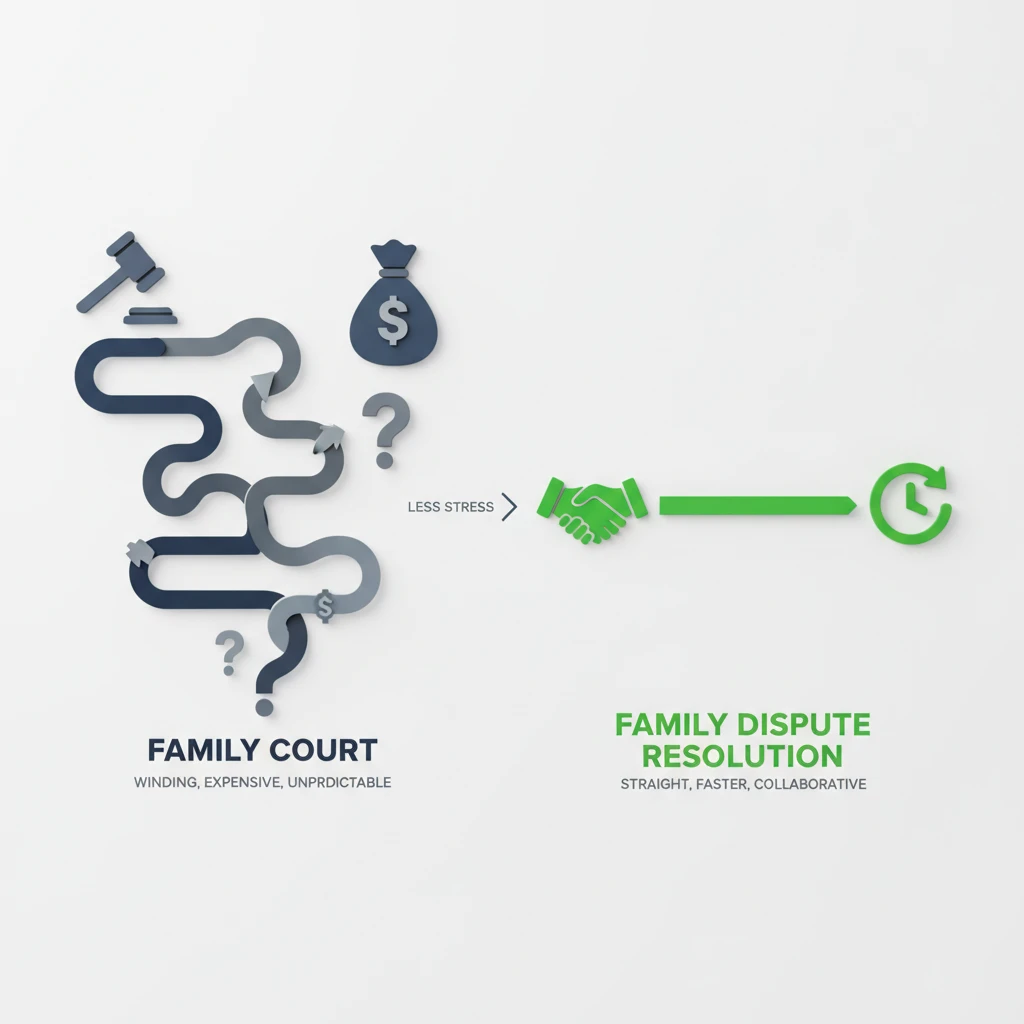
Benefits of Choosing FDR Over Litigation
While the mandatory nature of FDR might feel like a hurdle to some, it offers distinct advantages over traditional litigation:
- Control: In court, a judge decides your schedule. In FDR, you decide.
- Speed: Court cases can drag on for 18 months or more. FDR can often be concluded within weeks.
- Cost: As mentioned, FDR is a fraction of the cost of a full court hearing.
- Relationship Preservation: Litigation is adversarial and often destroys any remaining goodwill. FDR is collaborative and aims to preserve a working co-parenting relationship.
Conclusion
Family Dispute Resolution NZ is more than just a bureaucratic step; it is a vital mechanism for helping families navigate the difficult transition of separation. By prioritizing communication and the voice of the child, FDR helps parents build a sustainable foundation for the future. While the process requires compromise and emotional resilience, the outcome—a parenting plan created by parents, not judges—is almost always in the best interests of the family.
People Also Ask
Is family dispute resolution mandatory in NZ?
Yes, for most non-urgent parenting disputes regarding day-to-day care or guardianship, you are required by law to attempt Family Dispute Resolution (FDR) before you can file an application in the Family Court.
How much does FDR cost in New Zealand?
FDR is fully funded by the government if your income is below a certain threshold. If you do not qualify for funding, you pay a private fee to the provider, which is generally capped at a standard rate, making it significantly cheaper than hiring a lawyer for court proceedings.
What forms do I need for Family Court if mediation fails?
If mediation fails or the other party refuses to attend, the FDR provider will issue an ‘Outcome of Family Dispute Resolution’ form (often called the Section 12 form). You must attach this form to your Family Court application to prove you attempted mediation.
Can children participate in FDR?
Yes, through a process called ‘Voice of the Child’. A specialized practitioner meets with the children separately to understand their feelings and views, and then relays this information to the parents during the mediation session to help guide decisions.
How long does the FDR process take?
The timeline varies, but it is generally much faster than court. Once both parties engage, the process—including individual assessments, preparation, and the mediation session—can often be completed within 4 to 8 weeks.
What if the other parent refuses to attend mediation?
If the other parent refuses to participate, the FDR provider will issue a form stating that mediation could not proceed because of non-participation. You can then use this form to file your application in the Family Court.