
How to rekindle a relationship involves a deliberate combination of reintroducing novelty, deepening emotional vulnerability, and prioritizing intentional physical connection. To successfully bring the spark back, partners must actively disrupt stale routines to trigger dopamine responses, practice radical empathy to rebuild emotional safety, and often schedule intimacy to overcome the natural decline of spontaneous desire in long-term commitments.
The Science of Desire: Understanding the Coolidge Effect
When couples ask how to rekindle a relationship, they are often fighting against biology. In the early stages of a relationship, the brain is flooded with a cocktail of neurochemicals, primarily dopamine, oxytocin, and norepinephrine. This is often referred to as the “honeymoon phase.” However, as a relationship stabilizes, these chemicals subside to allow for a more sustainable, companionate love.
One of the primary biological hurdles in long-term relationships is known as the Coolidge Effect. In biological psychology, this phenomenon refers to the revival of sexual interest when a new partner is introduced. While this sounds discouraging for monogamy, understanding the mechanism is key to hacking it. The brain craves newness because new stimuli result in dopamine spikes. In a long-term relationship, the partner becomes a known quantity, and the dopamine reward system is less active during interaction.
To counter this, couples must understand that the loss of the “spark” is not necessarily a sign of incompatibility, but a biological inevitability that requires conscious intervention. By understanding that your brain is seeking novelty, you can stop blaming your partner for being “boring” and start collaborating on ways to introduce new stimuli into your shared environment. According to research often cited by the American Psychological Association, shared novel experiences can mimic the neurochemical rush of early romance.
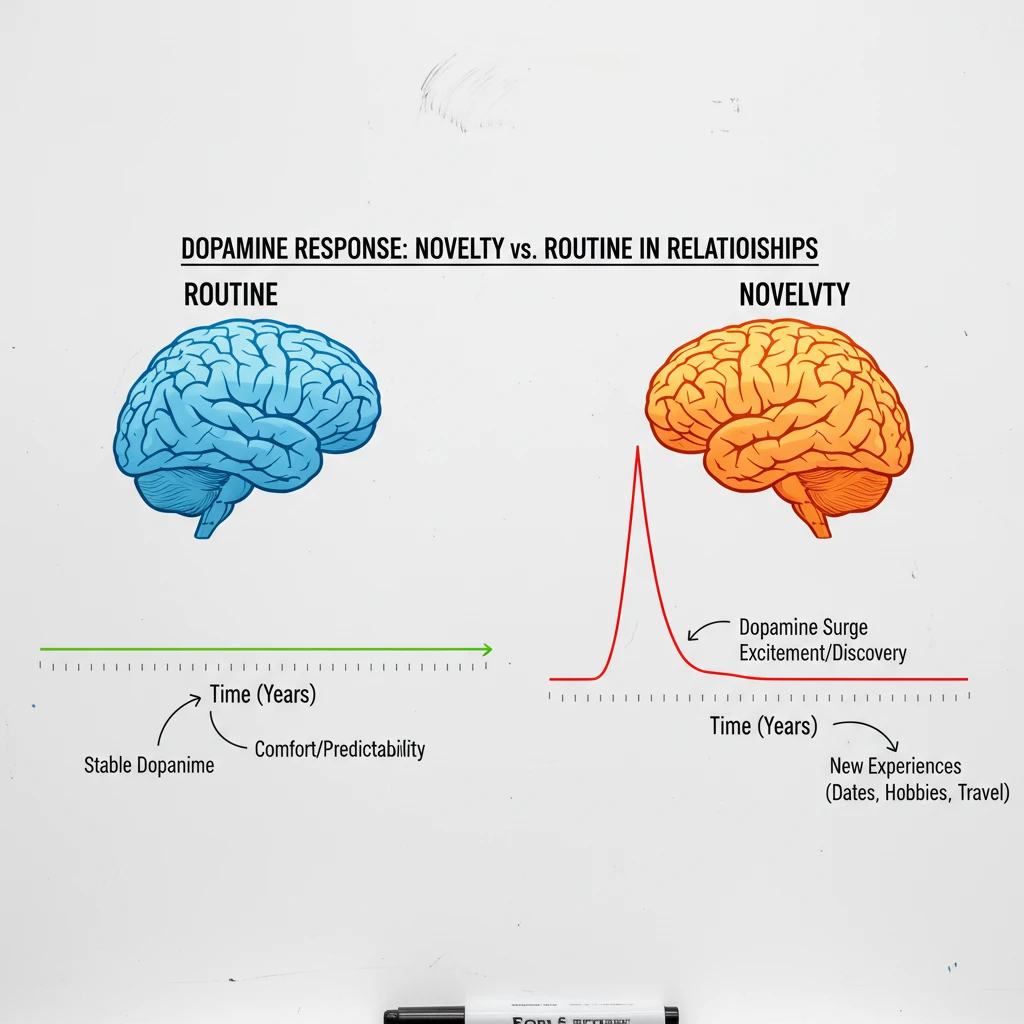
Novelty vs. Routine: The Psychological Tug-of-War
Routine is the enemy of desire, yet it is the best friend of security. This is the central paradox of modern relationships: we want safety and predictability (routine), but we crave adventure and mystery (novelty). When trying to figure out how to rekindle a relationship, the goal is not to destroy the security you have built, but to inject managed chaos into the system.
The Role of Adrenaline
Psychological studies have shown that misattribution of arousal is a powerful tool. When humans experience fear or adrenaline—like riding a roller coaster or watching a horror movie—the brain often confuses this physiological arousal with sexual attraction if a partner is present. If your date nights consist of dinner and a movie, you are feeding the routine. To bring the spark back, you must pivot toward activities that induce excitement.
- Try a new skill together: Learning a language, taking a dance class, or trying rock climbing forces you to be vulnerable and rely on each other in new ways.
- Change the environment: Even a weekend getaway to a town 30 minutes away can reset the context of your relationship. The brain processes the partner differently when the background changes.
- Surprise elements: Small, unexpected gestures release dopamine. This could be a surprise lunch visit or a random gift that shows you were thinking of them.
Deepening the Bond: Emotional Intimacy Exercises
Physical intimacy often withers because emotional intimacy has dried up. You cannot expect to have a passionate physical connection with someone you feel emotionally distant from. Rekindling the spark requires re-mapping your partner’s inner world.
Dr. John Gottman, a renowned relationship researcher, refers to this as building “Love Maps.” Over time, people change. The person you married five years ago is not the same person today. If you haven’t updated your knowledge of their fears, dreams, and stressors, you are essentially loving a stranger.
Exercise 1: The 6-Second Kiss
This is a simple but profound exercise. Most couples engage in a quick peck on the cheek when saying goodbye. Commit to a kiss that lasts at least six seconds. Why six seconds? It is long enough to stop the autopilot function of the brain and force a moment of genuine connection. It signals to your partner, “I am here with you, right now.”
Exercise 2: The Daily Stress-Reducing Conversation
Set aside 20 minutes a day to talk, but here is the rule: You cannot talk about the relationship or household logistics. No talk of bills, kids, or chores. The focus must be on external stressors. This creates an “us against the world” mentality, which fosters deep emotional bonding.

The Controversy and Efficacy of Scheduling Sex
One of the most polarizing pieces of advice on how to rekindle a relationship is the concept of scheduling sex. Many argue that it kills spontaneity and feels “unromantic.” However, sex therapists and relationship experts often argue the opposite: waiting for spontaneous desire in a long-term relationship is a recipe for a sexless marriage.
Responsive vs. Spontaneous Desire
It is crucial to understand the difference between spontaneous and responsive desire. Spontaneous desire (feeling horny out of nowhere) is common in the beginning of a relationship. Responsive desire means arousal kicks in after stimulation has begun. Many people, particularly women in long-term partnerships, operate on responsive desire.
Scheduling intimacy removes the “will we or won’t we” anxiety. It allows both partners to mentally prepare and look forward to the connection. It turns sex into a priority rather than something that happens only if there is leftover energy at the end of the day (which there rarely is).
How to Schedule Without Being Clinical
Don’t just put “Sex” on the Google Calendar. Use code words or agree that Tuesday nights are “Phone-Free Connection Nights.” The goal is to carve out protected time where intimacy is the primary objective, whether that leads to intercourse or just cuddling and talking naked. The intention is what matters.
Communication Strategies to Break the Silence
Resentment is the ultimate passion killer. If you are harboring unexpressed anger, it forms a wall around your heart that no amount of date nights can penetrate. To rekindle the relationship, you must clear the air.
Use “I” statements rather than “You” statements. Instead of saying, “You never touch me anymore,” try, “I feel lonely and I miss your physical affection.” This reduces defensiveness and invites the partner to comfort you rather than fight you. Furthermore, practice Active Constructive Responding. When your partner shares good news, celebrate it enthusiastically. Research shows that how you respond to good news is actually a better predictor of relationship health than how you respond to bad news.
A 7-Day Action Plan to Reignite the Spark
Theory is useful, but action is transformative. Here is a concrete plan to begin the process of rekindling your relationship immediately.
- Day 1: The Appreciation Bomb. Send three texts throughout the day stating specific things you appreciate about your partner.
- Day 2: The Nostalgia Trip. Spend the evening looking through old photos of when you first met. Remind your brains of the early dopamine rush.
- Day 3: Physical Touch Focus. Aim for five distinct moments of non-sexual touch (hugging, holding hands, a hand on the shoulder).
- Day 4: The New Experience. Cook a meal together that you have never eaten before, or go to a new part of town for a walk.
- Day 5: The Check-In. Ask the question: “What is one thing I can do next week to make you feel more loved?” Then, just listen.
- Day 6: Date Night. Go out. No phones allowed. Dress up as if you are trying to impress a new date.
- Day 7: Intimacy Night. Go to bed 30 minutes early with the intention of connecting physically, focusing on sensation rather than performance.
Rekindling a relationship is not a one-time event; it is a continuous practice of choosing your partner over and over again. By integrating the science of novelty, the depth of emotional vulnerability, and the discipline of scheduled connection, you can build a relationship that is not only resilient but passionately alive.

People Also Ask
How do you restart a relationship that has lost its spark?
To restart a relationship without a spark, you must break the routine that caused the stagnation. Start by introducing new shared activities to trigger dopamine, practicing active listening to resolve hidden resentments, and prioritizing physical affection through scheduled intimacy or daily touch rituals.
Can a relationship work if the spark is gone?
Yes, a relationship can work without the initial “spark” of infatuation, as this naturally fades into companionate love. However, for a relationship to be fulfilling long-term, couples usually need to actively cultivate desire and intimacy rather than waiting for it to happen spontaneously.
What are the signs that a relationship is rekindling?
Signs of a rekindling relationship include increased eye contact, more frequent laughter, a willingness to be vulnerable, a return of physical affection (holding hands, cuddling), and a mutual interest in planning future events together.
How long does it take to rekindle a relationship?
There is no set timeline, as it depends on the depth of the disconnection. Some couples feel a shift after a single intentional weekend, while others may need months of consistent effort and therapy to rebuild trust and desire. Consistency is more important than speed.
What is the 2-2-2 rule in relationships?
The 2-2-2 rule is a strategy to keep the spark alive: go on a date night every 2 weeks, go away for a weekend every 2 months, and take a week-long vacation every 2 years. This ensures consistent novelty and quality time.
How do you fix a relationship that feels like roommates?
To fix “roommate syndrome,” you must re-sexualize the dynamic. This involves moving away from purely logistical conversations (chores, bills), increasing non-sexual physical touch, flirting via text, and creating boundaries where you prioritize your role as lovers over your role as domestic partners.