
Family dynamics psychology is the study of the complex patterns of interaction, communication, and emotional bonding that occur within a family unit. It analyzes the family as an interconnected system where individual behaviors are shaped by roles, hierarchies, and boundaries, determining how members function collectively and how they influence one another’s mental health and development.
Systems Theory: The Foundation of Family Psychology
To truly understand family dynamics psychology, one must move beyond analyzing individuals in isolation and instead view the family as an emotional unit. This approach is rooted in Family Systems Theory, developed largely by Dr. Murray Bowen. The core premise is that a family is a system in which each member has a role to play and rules to respect. Members of the system are expected to respond to each other in a certain way according to their role, which is determined by relationship agreements.
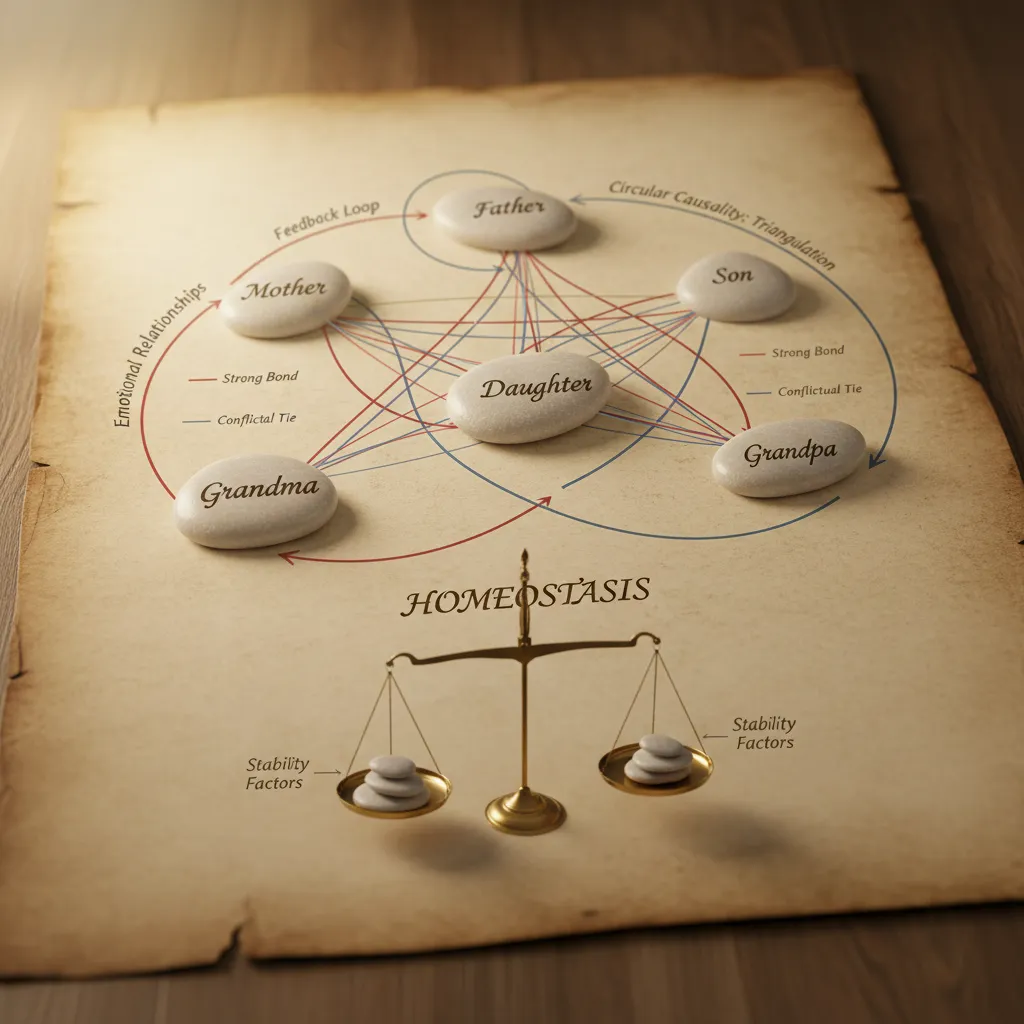
In this framework, the behavior of one family member cannot be adequately understood without examining the behavior of other family members. For instance, if one child is acting out (the identified patient), systems theory looks not just at the child’s pathology, but at the marital tension between parents that might be causing the child to seek attention or distract from the conflict. This concept is known as circular causality—the idea that events are related through a series of interacting loops.
The Concept of Homeostasis
Families, like biological organisms, strive for homeostasis or balance. When the family system is disrupted—whether by a positive event like a marriage or a negative one like a job loss—the members often unconsciously react to restore the status quo. Paradoxically, this can mean that a family might resist a member’s attempt to get healthy (e.g., getting sober or setting boundaries) because that change threatens the established, albeit dysfunctional, equilibrium.
Another critical component of systems theory is differentiation of self. This refers to the ability of a family member to maintain their own sense of self while remaining emotionally connected to the family. High differentiation allows for intimacy without losing autonomy, while low differentiation often leads to enmeshment, where emotions spill over from one person to another without boundaries.
The Psychological Impact of Birth Order
While often debated in pop psychology, the impact of birth order remains a significant area of study within family dynamics psychology. Alfred Adler was one of the first theorists to suggest that birth order influences personality, not because of the biological order of birth itself, but because of the psychological situation created by the position within the family structure.
The First-Born: Responsibility and Perfectionism
First-born children often enter a family environment where they are the sole focus of parental attention. As a result, they tend to be conscientious, ambitious, and dominant. However, when a sibling arrives, the first-born may experience a sense of “dethronement.” Psychologically, this often drives them to strive for excellence to regain parental approval and maintain their status as the responsible leader of the sibling pack.
The Middle Child: Diplomacy and Negotiation
Middle children occupy a unique position where they are neither the pioneer nor the baby. They often develop strong negotiation skills and diplomacy to navigate the power dynamics between older and younger siblings. In family dynamics psychology, middle children are frequently seen as the “peacemakers” or, conversely, they may feel squeezed out and seek belonging outside the family unit, relying more heavily on peer groups.
The Youngest and The Only Child
The youngest child often enjoys a more relaxed parenting style and may develop a personality that is charming, creative, or dependent, relying on others to take the lead. Only children, sharing characteristics with first-borns, often mature quickly due to extensive exposure to adult interactions but may struggle with peer conflict resolution that siblings naturally teach.
It is crucial to note that these are propensities, not destinies. Factors such as the age gap between siblings, gender, and physical traits can significantly alter these dynamic roles.
Healthy vs. Dysfunctional Family Structures
Distinguishing between a functioning family unit and a dysfunctional one is central to clinical psychology. No family is perfect, but healthy families exhibit patterns that foster growth, while dysfunctional families maintain patterns that inhibit it.
Characteristics of Healthy Families
In healthy family systems, boundaries are clear yet permeable. Parents maintain a hierarchy where they are in charge, but children’s voices are heard. Communication is direct rather than passive-aggressive. According to the American Psychological Association, healthy families possess resilience and flexibility, allowing them to adapt to stress without fracturing relationships.
- Emotional Safety: Members feel safe expressing vulnerability without fear of ridicule.
- Conflict Resolution: Disagreements are viewed as problems to be solved, not battles to be won.
- Respect for Autonomy: Individuality is celebrated, not suppressed.

Signs of Dysfunction
Dysfunctional families often operate under a rigid set of unspoken rules. Common toxic dynamics include:
- Triangulation: This occurs when two family members involve a third person to reduce tension between them (e.g., a mother complaining to her son about his father). This places an unfair emotional burden on the third party.
- Enmeshment: Boundaries are non-existent. A parent may live vicariously through a child, or family members may be overly involved in each other’s emotional lives to the point where individual identity is lost.
- The Scapegoat Mechanism: The family projects its collective anxiety and shame onto one member (the scapegoat), blaming them for the family’s problems to avoid facing the root issues.
Cultural Variations in Kinship Expectations
Family dynamics psychology cannot be universally applied without considering the cultural context. What is considered “enmeshment” in a Western, individualistic culture might be viewed as “filial piety” or healthy closeness in a collectivist culture.
Individualism vs. Collectivism
In individualistic societies (like the US and Northern Europe), the goal of the family is often to launch independent, self-sufficient children. The nuclear family is the primary unit. In contrast, collectivist cultures (such as in parts of Asia, Latin America, and Africa) prioritize the group over the individual. Here, the extended family is the standard unit, and intergenerational interdependence is expected and valued.
Psychologists must navigate these nuances carefully. For example, an adult child living with parents might be seen as a “failure to launch” in one culture, while in another, moving out before marriage might be seen as an abandonment of family duty. Understanding these baselines is essential for interpreting conflict and stress within the kinship network.
Navigating Conflict and Breaking Cycles
Understanding family dynamics is the first step toward healing. Many individuals find themselves repeating the patterns of their childhood in their adult relationships—a phenomenon known as the repetition compulsion. Breaking these cycles requires conscious effort and often therapeutic intervention.
Differentiation and Boundaries
To navigate conflict healthily, individuals must practice differentiation. This involves distinguishing one’s own feelings and thoughts from those of the family group. It allows a person to say, “I love you, but I disagree with you,” or “I am part of this family, but I will not participate in this toxic behavior.” Setting boundaries is not about punishing the family, but about protecting one’s own mental health.

For those interested in deep structural changes, Family Therapy often utilizes genograms (family tree maps that track psychological patterns) to visualize and interrupt intergenerational transmission of trauma. By identifying that a pattern of avoidance or aggression didn’t start with you, but was passed down, it becomes easier to lay the burden down and choose a different path.
People Also Ask
What are the 4 types of family dynamics?
While there are many models, four common parenting styles that create specific dynamics are Authoritative (high warmth, high standards), Authoritarian (low warmth, high control), Permissive (high warmth, low control), and Neglectful (low warmth, low control). Each creates a different psychological environment for children.
How does psychology define family?
In psychology, family is defined more by function and emotional connection than just biology. It is a system of interconnected individuals who share a history, emotional bonds, and a sense of future obligations, regardless of whether they are related by blood, marriage, or adoption.
What causes poor family dynamics?
Poor dynamics are often caused by untreated mental illness, substance abuse, rigid personality traits, financial stress, or intergenerational trauma. A lack of communication skills and poor boundary setting also contribute significantly to dysfunction.
How do you fix toxic family dynamics?
Fixing toxic dynamics requires acknowledging the problem, establishing firm boundaries, and improving communication. It often requires the help of a family therapist to mediate and teach new patterns of interaction. In some cases, limiting contact is necessary for safety.
What is the role of the scapegoat in a family?
The scapegoat is the family member who is blamed for the family’s difficulties. This role allows the other family members to avoid taking responsibility for their own actions or addressing the true underlying conflicts within the system.
Why is understanding family dynamics important?
Understanding these dynamics is crucial because they shape our personality, attachment styles, and how we handle conflict. Recognizing these patterns allows individuals to break negative cycles, improve current relationships, and raise their own children with greater awareness.